Three different people, writing on three different platforms, in three different industries, described essentially the same job this week. Aaron Levie called it the "agent deployer and manager" in a LinkedIn post about enterprise CIO conversations. Marvin Chow, VP of Global Marketing at Google, called it the "marketing engineer" and is creating the role on his team. Vineet Mehra's framework (distilled by Reggie Panaligan) named one of its five CMO competencies "AI Conductor."
Nobody cited anybody else. Each arrived at the same profile independently: someone who can map a business process end to end, identify where an agent replaces a bottleneck, build or configure the system, and manage it in production. Technical enough to wire up MCP (Model Context Protocol) servers and CLI tools. Process-fluent enough to know which workflows matter. Politically skilled enough to get buy-in.
That convergence was the most interesting signal of the week. But so was the gap between these emerging job descriptions and what the hiring data actually says.
TL;DR
- Three voices, three platforms, one job: Levie described the "agent deployer," Chow described the "marketing engineer," and Mehra described the "AI conductor." None cited each other. All described someone who maps business processes and wires up agent systems.
- Korn Ferry surveyed talent acquisition leaders and the #1 skill for 2026 is critical thinking. AI skills rank fifth. The meta-skill beats the tool skill.
- Garry Tan published the most specific agent architecture breakdown I've seen: five definitions, a three-layer stack, and a feedback loop tested at YC Startup School with 6,000 founders.
- Anthropic's run rate surged from $14B to $30B in two months. A leaked OpenAI memo positions them as a "single-product company." Both companies plan to IPO this year.
- Allbirds sold its sneaker brand for $39M, rebranded as NewBird AI, and is now selling GPU-as-a-Service. The stock popped.
The role that appeared in three inboxes
Levie's version is the broadest. From his enterprise conversations, every functional team will need its own agent deployer. Distributed practitioners, reporting to IT or AI leadership, with full autonomy to connect systems and drive automation. His focus is 100x workflows: lead processing, contract review, client onboarding. Wholesale replacement of entire workflow steps.
He followed up later in the week by arguing that forward deployed engineers are more critical in the agent era. Selling agents, he wrote, "is far closer to a customer buying from a professional services firm than implementing traditional technology." The four requirements: deep domain understanding, system wiring, context setup, and change management. Every system integrator and consulting firm is spinning up new practice areas around this.
Chow's version is narrower and equally specific. At Google, the marketing engineer orchestrates AI systems to solve real problems, "rather than just typing prompts into a box." His examples are pipelines: brand mention sentiment alerting, real-time competitor battlecard updates, rapid prototyping. The hiring framework starts with process mapping, moves to bottleneck identification, then building, then measuring pipeline impact. "Build it" is step three.
Mehra's version comes from the C-suite. The future CMO is a "five-headed hydra": AI Conductor, Financial Strategist, Community Architect, Cultural Decoder, Talent Multiplier. The AI Conductor label is the cleanest articulation I've seen of what fluency looks like when it becomes a dedicated leadership competency.
Three angles, one archetype.
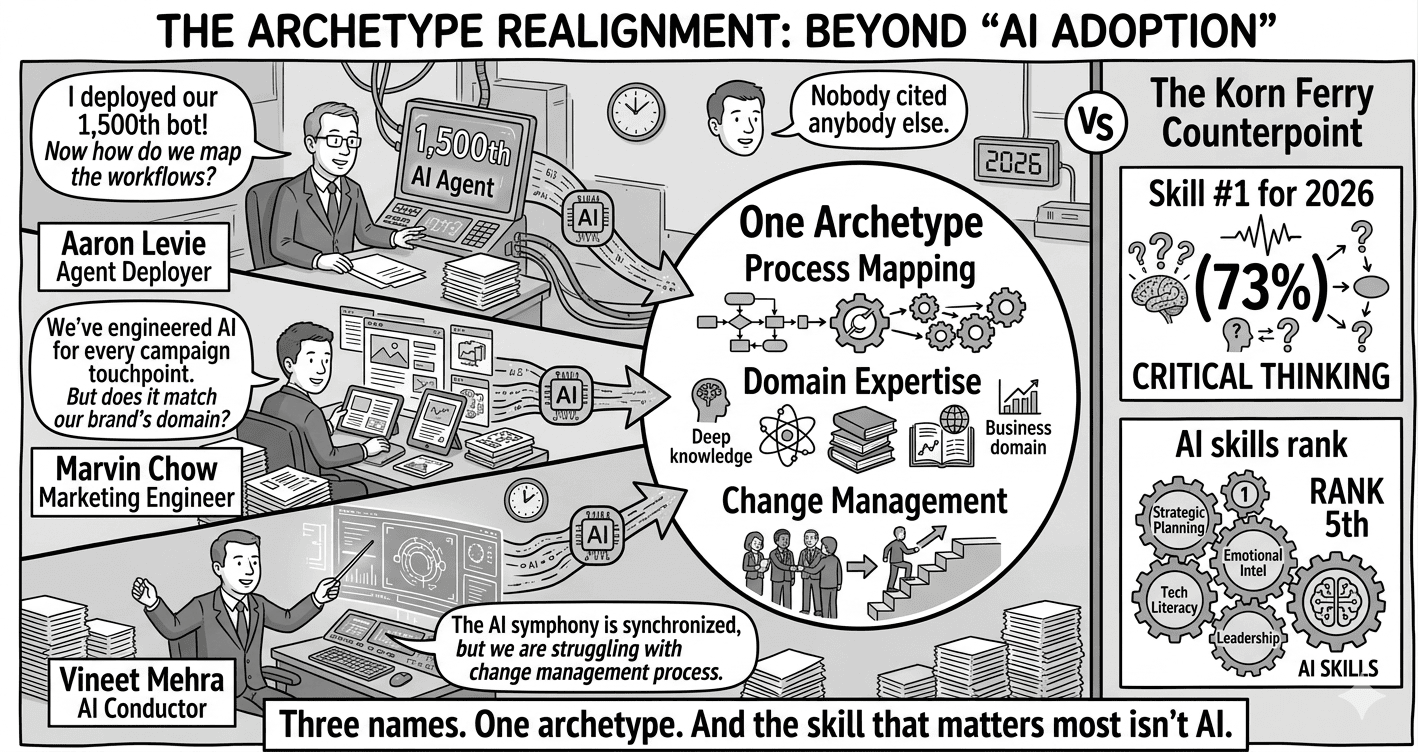
And then there's data that complicates the picture. Korn Ferry published their 2026 talent acquisition report in early April, and it landed in my scan this week.
Their 2026 talent acquisition report surveyed TA leaders and found that 73% rank critical thinking as the #1 skill for the year. AI skills ranked fifth. The meta-skill beats the tool skill. Employers want people who can assess AI output, spot flaws, and know when to override. They also found that 52% plan to add autonomous AI agents as team members, and only 22% believe leaders can effectively manage human-AI teams despite billions in investment.
The tension is productive: organizations are naming agent-era roles that require process mapping, domain expertise, and change management. And the scarcest capability isn't AI proficiency. It's judgment.
The architecture that got specific enough to argue about
While the job titles were crystallizing, the architecture underneath them crossed from theory to playbook.
Garry Tan published the most precise breakdown I've read. The YC president and CEO laid out five definitions that separate 2x productivity from 100x:
- Skill files reusable procedures the model follows.
- The harness thin, just runs the model in a loop and manages context.
- Resolvers routing tables that load the right context for each task.
- The latent/deterministic split the most common agent design mistake is forcing deterministic problems into LLM territory.
- Diarization structured profiles synthesized from dozens of documents, where the model holds contradictions and makes judgment calls.
His CLAUDE.md was 20,000 lines before he realized it was degrading model attention. The fix: roughly 200 lines of pointers.
The three-layer stack: fat skills on top (90% of the value), thin CLI harness in the middle, deterministic tooling on the bottom. Push intelligence up, push execution down, keep the middle thin. At YC Startup School, with 6,000 founders, a self-improving feedback loop brought "OK" ratings from 12% down to 4%.
Adam Miller made the leap from architecture to product. He wrote about Goose, an open-source agent runtime under the Agentic AI Foundation (a Linux Foundation umbrella body), and his central claim is blunt: over 90% of agent use cases don't require custom development. "Stop building agents, start harnessing them." Goose's three-element design mirrors Tan's stack: interface, agent runtime, pluggable MCP extensions. The competitive layer, Miller argues, is "Harness Engineering," building the enablement layer around agents rather than reimplementing core functionality.
Andrew Ng formalized the same pattern for individual developers. Spec-driven development: write a specification that defines what to build, then work with a coding agent to implement it. The spec is persistent context that survives across sessions. Ng's claim is that many of the best developers already work this way.
Ethan Mollick, writing in late March, added the interface layer. The gap between AI capability and actual usefulness, he argued, is an interface problem. Most users interact through chatbots that dump walls of text. Claude Dispatch decouples the control interface from the execution environment: you direct the agent from your phone while it works on desktop files. Adaptive interfaces, where the AI generates the right tool for each moment, are where Mollick sees this heading. If he's right, the harness needs an interface layer on top of Tan's three-layer stack.
From the archives: Maria Weaver published something back in January that I only found this week, and it reframes everything above. She applied the skills pattern to personal life. She built a chained Claude Code system for weekly, monthly, and quarterly planning. Each skill reads the output of the previous layer. Calendar reminders trigger the cadence. Her framing: Claude Code skills are externalized "implementation intentions" from behavioral psychology, if-then plans that work through automaticity. For her ADHD brain, the skill file holds the behavioral link that unreliable memory can't. "The system doesn't make me more disciplined. It makes discipline irrelevant."
The numbers that explain why every vendor sounds the same
The architecture is getting specific. The money following it is getting specific too.
Anthropic's run rate surged from $14B to $30B between February and April. Enterprise contracts exceeding $1M are routine. An IPO is planned within six months.
Meanwhile, a leaked four-page memo from OpenAI's chief revenue officer laid out a different strategy. Five enterprise priorities: own the model layer, own the agent platform, expand through Amazon distribution, sell the integrated stack, own deployment. The language toward Anthropic was aggressive, framing them as ideologically restrictive and alleging an $8B run-rate inflation through accounting treatment. The memo's most revealing line: "the companies that win enterprise AI will not just have the best models. They will have the best ability to get those models deployed."
Saanya Ojha read the same signals differently. OpenAI, she argued, is executing a quiet pivot from spectacle to "workflow position." GPT-Rosalind (a biology-focused reasoning model) signals vertical specialization. An expanded Codex, now with workflow automation and memory, signals horizontal platform play. While Anthropic dominates headlines, OpenAI is building switching costs through infrastructure embeddedness.
The question neither company is answering directly: why does every vendor pitch sound the same? Jaya Gupta provided the structural explanation. Before AI, enterprise data had clear layers with clear owners. CRM data had a CRM buyer. Warehouse data had a data team. Now, state spans five or more layers simultaneously with no consolidation, unclear ownership, and every layer interacting with every other. Every AI vendor genuinely needs access to the same data. So every vendor makes the same claim: "We're the safe, trustworthy, enterprise-grade way to give AI access to your data." The convergence is structural.
CIOs are being pitched fifty times a week on essentially the same story by companies doing genuinely different things. Gupta's diagnostic for enterprises that want to cut through: "Which of the state layers do you own, how does it interact with the others, and what happens to the state you accumulate when we end the relationship?"
The Odd Find
A sneaker company walked into a GPU.
Allbirds, once valued at roughly $4B, sold its footwear brand for $39M, raised $50M in convertible financing, rebranded as NewBird AI, and announced a GPU-as-a-Service business. The stock surged. Saanya Ojha placed it in a lineage: Long Island Iced Tea rebranding as Long Blockchain in 2017 (stock tripled overnight), Kodak's crypto pivot in 2018 (stock tripled), Bioptix becoming Riot Blockchain. When a company's original business collapses, the ticker symbol itself becomes the primary asset. A publicly traded vehicle for whatever narrative the market currently rewards.
What I'm thinking about after this week's reading
Azeem Azhar shared a Nature Communications paper this week that reframed everything else I read. Researchers studied 285 polities across six continents over 10,000 years and found two quantified thresholds: a scale threshold and an information-processing threshold. Civilizations grow until they hit a coordination ceiling. The ones that survive invent new tools for processing information: writing, currency, bureaucracy. The ones that don't, collapse.
Azhar's framing: we're at one of those ceilings now.
Mike Fisher, writing about product organizations, made a version of the same argument at a smaller scale. The fundamental failure mode is confusing outputs with outcomes. He told the Langley vs. Wright brothers story: Langley optimized for visible progress and failed. The Wrights optimized for understanding the problem and succeeded nine days later. ROI, Fisher argues, is "a terrible product manager" because it cannot see second-order effects like trust, habit formation, or emotional resonance. Good teams measure learning velocity, not feature count.
The thread I keep pulling: the new roles being named right now (agent deployer, marketing engineer, AI conductor) are information-processing innovations. They exist because organizations hit a coordination ceiling they can't clear with existing structures. The architecture getting specific (thin harnesses, fat skills, spec-driven development) is the tooling response. The platform war ($30B run rates, deployment strategy, vendor convergence) is the market's attempt to own the infrastructure layer beneath it all.
And the Korn Ferry finding that critical thinking outranks AI skills is the quiet signal underneath the noise. The tools change. The judgment doesn't. That's what the new roles actually require.