I've been writing about a structural shift for months. That AI would reorganize enterprise software from the inside out. That the real challenge would be infrastructure, not generation. That connectors without architecture would be expensive and fragile.
For most of that time, these were arguments. Good ones, I think, but still arguments. The kind of thing where you lay out the logic, cite a few early signals, and wait.
Last week, I stopped waiting.
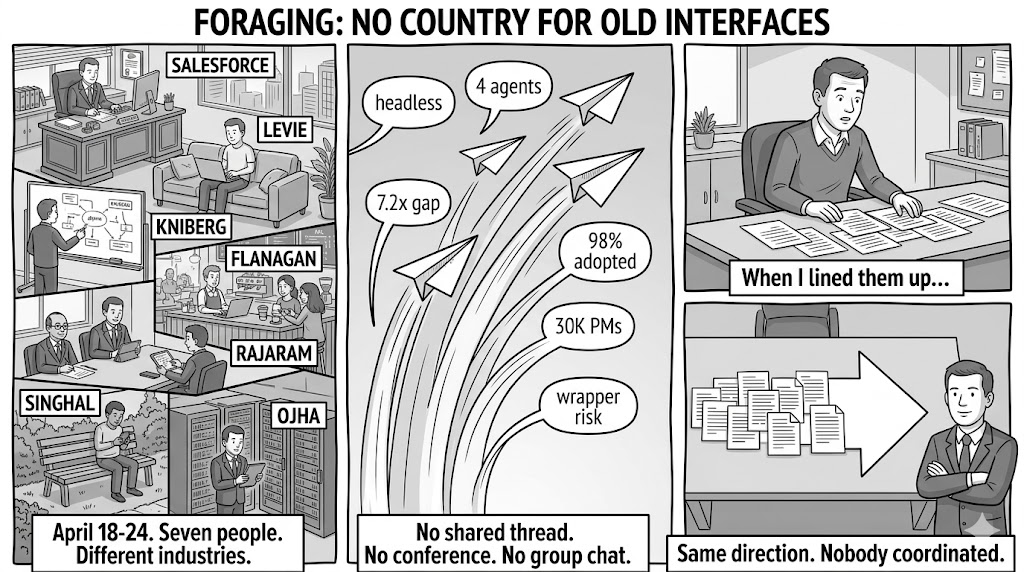
In the space of a week, seven writers working independently arrived at the same structural argument. Different industries, different audiences, no shared thread connecting them. When I lined up what they published, the overlap was hard to explain as coincidence.
Three structural shifts are now visible. Together, they're a preview of the next eighteen months.
TL;DR
- Salesforce announced Headless 360, exposing CRM capabilities as APIs for agent consumption. The same system now serves humans through a UI and agents through APIs, adapting to whoever is consuming it. Levie's formula: "Seats for the people, consumption for the agents." Cursor's $60B SpaceX/xAI deal exposed what happens when your interface layer is someone else's model.
- PwC found 75% of AI's economic gains captured by 20% of companies, at a 7.2x performance gap. Flanagan (former HubSpot SVP) found 98% CMO adoption but fewer than 33% see returns. His independently derived four-layer architecture echoes From Content Generation to Content OS.
- Rajaram called coding "the canary vertical," with legal and finance 12-18 months behind. Kniberg, creator of the Spotify Model, runs his new company on four agents with daily releases. Singhal predicts 30K PMs shed, 8K rehired AI-first.
- Ramp AI Index: Anthropic gained 6.3 points in a single month, predicted to overtake OpenAI in enterprise share within 60 days. Business AI adoption crossed 50%. The strongest predictor of adoption is investor backing type.
- Gensler surveyed 16,400 workers across 16 countries. AI power users spend less time alone, more time learning and socializing. The isolation narrative doesn't survive contact with behavioral data.
The interface went liquid
For decades, Enterprise SaaS meant a fixed interface: screens, buttons, workflows designed for a human sitting in a chair. What happened this week is that the interface started to dissolve into something malleable. The same underlying system now serves different surfaces to different consumers, adapting its shape to whoever is calling.
Salesforce made the most structurally honest move of its AI era. After years of rebranding capabilities (Einstein, Einstein GPT, Einstein Copilot, Agentforce), the company announced Headless 360: CRM capabilities exposed as APIs and tools for direct agent consumption. The human interface stays. But now there's a parallel surface, shaped for agents, running alongside it. The same CRM, two entirely different experiences, each adapting to its consumer.
This is the shift. The interface didn't die. It multiplied. A marketer still sees dashboards and campaign builders. An agent sees tool schemas and structured data. A workflow orchestrator sees API endpoints and permission boundaries. Each consumer gets the surface that fits how it works.
Aaron Levie has been building toward this framing in real time. In a detailed thread, he laid out the business model case: software has been constrained by how much people can do in a given day. Agents remove that constraint entirely. They work 24/7, run in parallel, and use platforms far more than humans ever did.
Instead of reviewing contracts one by one, agents review all of them. Instead of running a handful of marketing campaigns, agents run ten times more. His formula is clean: "Seats for the people, consumption for the agents." Same platform. Two modes of engagement. The interface adapts to whoever shows up.
The same week, Cursor discovered what happens when your interface layer belongs to someone else. Saanya Ojha's analysis of the SpaceX/xAI deal is the sharpest wrapper-vulnerability case study I've read. A $50B company, at peak momentum, forced to reckon with the fact that its most critical supplier is also a potential competitor. Anthropic had already demonstrated the leverage: during acquisition rumors, they cut Windsurf's Claude access entirely. If the malleable interface is the new value layer, owning it matters. Renting it from a model lab that can revoke access is a structural risk.
Alexander Atzberger, CEO of Optimizely, declared MACH dead. The technical plumbing standards are adopted. What matters now is the orchestration layer that decides which surface serves which consumer. "The suite always wins," he wrote, positioning Optimizely's Opal as that orchestration platform. Whether you agree with the vendor framing or not, the structural claim is right: the static interface is commoditized. The dynamic, adaptive layer above it is where the value moved.
In March: "MCP gave us the plumbing. But most implementations forgot to build the house." Salesforce, Levie, Cursor, and Atzberger all published evidence this week that the house, the adaptive layer that shapes itself to whoever is consuming the software, is now the only thing that matters.
The returns gap is real and widening
Here is a number that should keep every CMO awake: 98% of them use AI. Fewer than a third see the expected returns.
Kieran Flanagan, former SVP of Marketing at HubSpot, diagnosed why. The systems produce more, not better, because they lack marketing fundamentals. No audience context. No voice. No feedback loops. He cited Ries and Trout from 1981: "The mind has always been the market." AI systems without marketing understanding produce volume without depth.
His proposed fix is where it gets interesting. A four-layer Claude Code architecture: context (audience language, voice, positioning as .md files), rules (CLAUDE.md under 60 lines), reach (live stack integration for real data), and operation (skills that compound with each run). That maps almost exactly to the four pillars I described in From Content Generation to Content Operating System: orchestration, knowledge integration, quality evaluation, and closed-loop measurement. Context is knowledge integration. Rules are orchestration. Reach is measurement. Operation is orchestration plus quality. We arrived at the same architecture from different starting points.
The pattern is visible at the enterprise level too. PwC surveyed 1,217 senior executives across 25 sectors and found that 75% of AI's economic gains are captured by just 20% of companies. The leaders deliver 7.2x the financial performance of their peers. They are 1.9x more likely to use autonomous AI and are removing human intervention at 2.8x the rate. The gap is widening.
Stanford HAI's data tells the same story from a different angle: 88% of organizations use AI. Single-digit percentages have mature deployments delivering real value.
And the Ramp AI Index crossed its own threshold this month: business AI adoption hit 50.4%, up from 35% a year ago. The most striking finding isn't the adoption rate. It's that the strongest predictor of adoption is investor backing type. VC-backed companies: 80%. PE-backed: 64%. Everyone else: 45%. VCs are functioning as transmission mechanisms, pushing tools into portfolios faster than organic adoption would.
Read those numbers together. 98% CMO adoption. 88% across all organizations. 50% business adoption. 75% of economic gains concentrated in 20% of companies. Single-digit maturity rates.
Everyone adopted. Architecture is the problem. "The generation problem is largely solved. What's not solved is everything around it." I wrote that in March. It was a claim. Now it's a data point.
The canary is singing
Gokul Rajaram made the timeline concrete. In a LinkedIn post, he called coding "the canary vertical," the first industry where AI reached mainstream disruption. The reason coding leads: objective feedback loops. Code runs or it doesn't. Tests pass or they fail. That signal richness accelerated model capability beyond law, finance, or medicine.
His timeline: legal and finance are 12-18 months behind coding. Healthcare is further out. Every knowledge-work vertical will follow the same path, just on a delayed curve.
The same week, Henrik Kniberg, the creator of the Spotify Model, showed what the endpoint looks like. His new company, Abundly, runs on four specialized agents: one writes code, one converts Slack messages into Notion tickets, one handles releases end-to-end, and one (named Grace) coordinates the others, handles stakeholder requests, and improves herself based on team feedback. They ship platform releases daily. The engineers focus on design, architecture, and UX. Grace is "effectively improving the platform that she is running on."
A production system at a real company, built by someone who literally wrote the book on how software teams organize.
Nikhyl Singhal extended the disruption into product management with the most aggressive headcount prediction I've seen: companies will shed 30,000 PMs and rehire 8,000, all AI-first. Wholesale replacement. The credentials that used to matter are devaluing fast.
At Sierra, Bret Taylor's company scrapped its coding interview entirely. The replacement: candidates drive product ideation, build for two hours with any AI tools they choose, then demo and discuss. The evaluation criteria shifted from "can you write code" to "can you think about products and use AI with judgment." At Intercom, the top five power users of their Claude Code deployment weren't engineers. They were designers, PMs, and TPMs.
The canary vertical now has a concrete timeline: a production case study, a headcount prediction, and a scrapped interview format attached to it. And the pattern will replay in every knowledge-work vertical on Rajaram's timeline.
The counter-signal
One dataset pushes against the disruption narrative.
In March, the Gensler Research Institute surveyed 16,400 office workers across 16 countries. 30% now qualify as "AI power users." The headline finding: power users spend less time alone (37% vs. 42%), more time learning (12% vs. 8%), and more time socializing (11% vs. 9%). They report stronger team relationships and spend nearly twice as much time at client sites and coworking spaces.
The most common objection to deep AI adoption, in every change management conversation I've been part of, is that it isolates people. The behavioral data suggests the opposite: AI automates solitary cognitive work, freeing capacity for the collaborative work organizations actually need more of.
The disruption is real. The human cost may be more nuanced than the headlines suggest.
The Odd Find
AI's biggest productivity boost landed somewhere nobody expected: at home.
Stanford SIEPR researchers tracked over 200,000 U.S. households and found that AI delivers 76-176% efficiency gains on digital chores: job hunting, travel planning, comparison shopping, scheduling. Dramatically, measurably faster.
What people did with the freed time is the odd part. They watched Netflix. They scrolled Instagram. The productivity gains were real, and the reinvestment went to leisure.
Younger, higher-income households adopted faster, widening the digital divide. But the finding that sticks: the productivity paradox inverted. AI makes people dramatically more efficient at the things that don't show up in any company's productivity metrics. The gains are real. They just landed in the wrong spreadsheet.
What I'm thinking about after this week's reading
None of these signals are surprising in isolation. Levie has been building the headless case in public for weeks. The returns gap data has been trickling in. The coding disruption was already visible in Stanford HAI's developer employment numbers.
What's new is the convergence. Seven unrelated voices, in the same week, all publishing evidence that this shift is no longer theoretical. Salesforce restructuring around agents. Cursor discovering it's a wrapper. PwC quantifying the concentration. Kniberg running a company on four agents. Flanagan independently deriving the same four-pillar content architecture.
The interface is going liquid, and the returns concentrate where the infrastructure exists. Every knowledge-work vertical now sits somewhere on Rajaram's curve.
I should be transparent: the infrastructure layer I keep pointing to (orchestration, knowledge integration, quality evaluation, closed-loop measurement) is the problem space I work on at Typeface. But these numbers came from PwC, Stanford, Ramp, a former HubSpot SVP, and Optimizely's CEO. The convergence is structural, not convenient.
The technology is the easier part. It always has been.