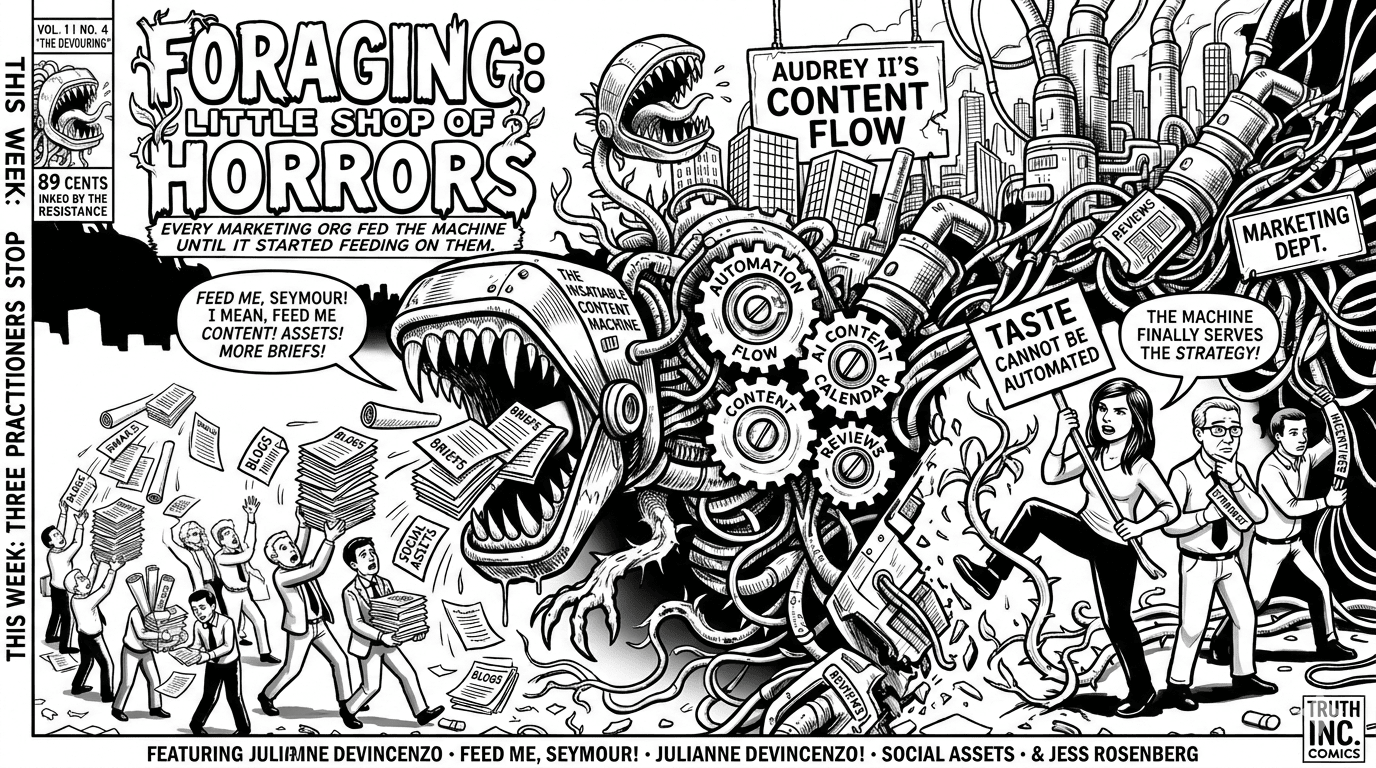
There is a confession I hear in almost every conversation with a marketing leader. It surfaces sideways, usually after the second or third meeting, once the vendor pitch is over and we're talking honestly. "We built the machine. And now we can't stop feeding it."
The details vary. Sometimes it's the monthly content calendar with 47 line items that nobody reads. Sometimes it's the review process that takes longer than the writing. Or the agency relationship where the briefs became the product and the content became filler. One leader told me her team went from writing ten blog posts a quarter to sixty, and not a single one outperformed the original ten. The specifics change. The exhaustion is always the same.
I build content infrastructure at Typeface, so I hear these confessions more than most. But what struck me this week wasn't any single conversation. It was that two people I'd never connected before, working in completely different contexts, described the same structural trap from the inside. And the way they're escaping it tells us something about where marketing is right now, beneath the AI adoption numbers.
Like-Minded Lunatics
Julianne DeVincenzo runs global content strategy at Optimizely. In an interview with State of Brand, she described what she inherited with a line I can't stop thinking about: "We spent so many years feeding the machine that we forgot we ever loved the work."
Her diagnosis is precise. Content teams became order-takers operating what she calls the "butcher counter model," where everyone takes a number and waits for their request to be filled. The strategy served the machine rather than the other way around. High volume, low coherence, no one asking whether the output mattered.
DeVincenzo didn't reorganize from the top down. She found what she calls "like-minded lunatics," people already in pain from existing systems, and built a coalition from the middle. It took seven months. Sales teams joined unexpectedly, recognizing the same dysfunction from their side. The mandate that emerged: make the team "structurally smaller and dramatically more capable." Subject matter experts now communicate directly rather than routing everything through marketing approval. The machine finally serves the strategy.
At AirOps, Jess Rosenberg faced a different version of the same problem when building Quill, their AI marketing agent. The default AI voice was available out of the box: that eager, hedge-stacking, congratulatory tone that sounds like every chatbot you've ever closed. Her team rejected it. They built an archetype they called the "Expert Colleague": a mentor with earned authority. Warm, confident, direct, occasionally surprising.
The banned-patterns list proved as important as the voice principles themselves. They wrote it as carefully as the positive guidelines: no hollow affirmations, no hedge-stacking, no congratulatory openers, no "aren't just X, they're Y" constructions. The entire voice system was delivered to engineering as a markdown file. Rosenberg's thesis: "Capability without character is forgettable." Domain expertise earns the right to have personality. Everything else is wallpaper.
DeVincenzo told one more story. Her AI tools kept flagging em dashes as unnecessary. She overruled them. Not because em dashes are sacred, but because letting an algorithm make your stylistic choices is where voice starts to die. (I ban em dashes in my own writing, so the irony is not lost on me.) Her reasoning: "Taste cannot be automated."
What the Dashboards Miss
Taste cannot be automated. And the data is starting to prove it.
DeVincenzo is not alone in the diagnosis. A BuildBetter survey surfaced a number that stopped me cold: 84% of product leaders claim AI is integrated across their lifecycle. Only 18% of the managers who do the work agree. That's a 4.7x perception gap between the people who approve the dashboards and the people who live inside the workflows.
The machine looks different from the top than it does from the middle. And that gap matters because the people who decide whether to deploy AI across content operations are often the same people most insulated from the experience of using it. The dashboard says integrated. The workflow says otherwise. DeVincenzo saw this firsthand: the executives who approved the content calendar had no idea what it felt like to fill it.
On the consumer side, the antibodies are forming fast. According to a recent study tracking consumer attitudes toward AI-generated content, enthusiasm collapsed from 60% to 26% in roughly two years, with young adults (22-34) detecting AI writing at nearly 89%.
Volume is cheap. Trust is expensive. And trust is the thing you can't scale by adding more tokens.
If you're a marketing leader reading those numbers, the implication is uncomfortable. The same AI tools that gave your team a productivity bump are simultaneously training your audience to distrust the output. The speed gain is real. The credibility cost is real too. The question is which one compounds faster.
DeVincenzo didn't reject AI. She used it for research, ideation, and structural work, then kept humans in control of editorial judgment. The restraint was the strategy. You could call it taste. You could also call it knowing which decisions to protect from the machine you built.
I wrote a few weeks ago about the multiplayer problem in AI productivity: the gap between individual speed and organizational compounding. What DeVincenzo and Rosenberg are showing is the layer beneath that problem. Before you can build shared infrastructure, someone has to remember what the infrastructure is for. Coordination assumes shared purpose. These practitioners had to rebuild the purpose first.
Everyone I talk to agrees the machine is broken. The interesting divergence is in what they do next. Most organizations respond by adding another layer: a governance framework, a brand guide, a review stage, a new tool on top of the old tools. DeVincenzo and Rosenberg went in a different direction. They asked who still cares, and they gave those people authority.
I've been writing about content operating systems for months. The thesis has always been structural: the real leverage sits in the infrastructure layer, in shared platforms, in the organizational compounding that individual tools can't deliver alone. I still believe that framing is right. But this week's convergence sharpened something I'd been underweighting.
Infrastructure without conviction is just plumbing. You can build the platform, wire the knowledge graph, close the measurement loop. And if the people inside the system have forgotten why the work mattered in the first place, the infrastructure automates the emptiness. The system runs faster, but it's running nowhere.
The Odd Find
Spotify turned 20 this month and celebrated by replacing its logo with a disco ball. For five days. The backlash was immediate and loud, which was exactly the point. Every complaint was free distribution. A five-day deviation from a decade-old brand identity generated more conversation than most companies achieve in a year. They didn't add a feature or launch a product. They temporarily broke the most recognizable thing they had, on purpose, and let the breakage do the work.
DeVincenzo's "like-minded lunatics" aren't a change management tactic. They're a taste test. The question she's really asking: does anyone here still care enough to fight the machine we built?
The machine is always hungry. The question is whether you remember what you were trying to cook.