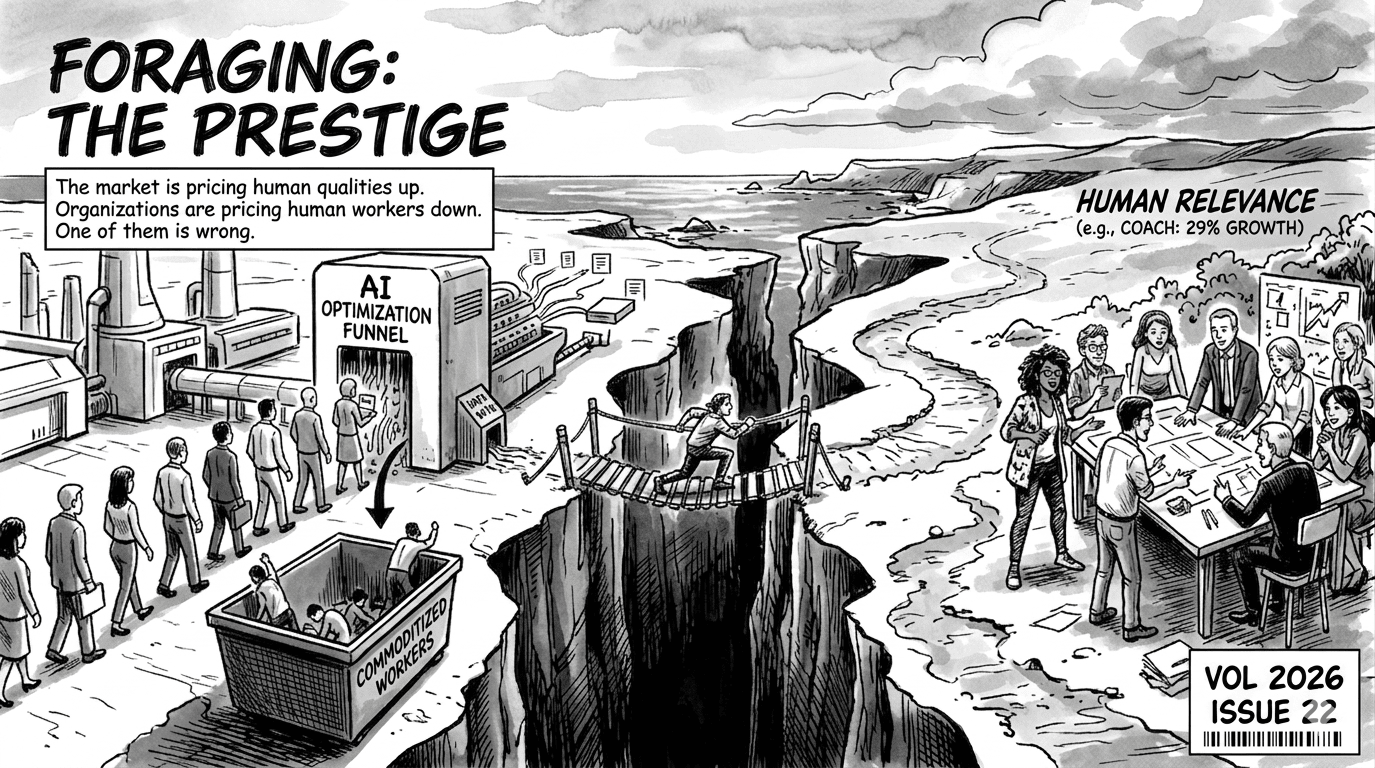
Coach grew 29% last year on a bet that would have gotten most CMOs fired: human relevance over performance optimization, in a year when every other enterprise was chasing the opposite.
Joon Silverstein, Coach's global head of marketing, laid out the numbers at Brandcast NYC: 15 million organic engagements, 450,000 user-generated posts, a 60% awareness lift among Gen Z. Stop treating brand as the top of the funnel. Brand is the funnel. Relevance-first, while every competitor doubled down on attribution models and AI-powered optimization.
Meanwhile, a Gartner study of 350 executives at billion-dollar companies found that 80% of organizations deploying autonomous AI have already cut their workforce. The layoffs aren't delivering returns: reduction rates are nearly identical among companies reporting high ROI and those seeing none.
One side of the market is rewarding human conviction. The other side is punishing human hesitation, in the same year, in the same economy. The contradiction is a sorting.
The Human Quotient
Human understanding, judgment, creativity, and trust are becoming even more valuable, not less. That's the central thesis of the Marketing2030 report, released this week by the Institute for Real Growth and Oxford's Said Business School.
They call it the Human Quotient: the compound of human and AI, where human capabilities serve as the multiplier. The report, built from interviews with global business leaders, argues marketing is being redefined from a communications function to an enterprise capability centered on understanding people, culture, trust, and value creation.
If you buy that framing, the CMO role doesn't shrink. It becomes the most consequential function in the building.
Eugene Healey would push back on the timing. He documents the structural instability: the CMO already has the shortest C-suite tenure, a 54% misalignment rate with their board, and a growing number of systems-thinking leaders from other functions circling the job. His "barbell model" predicts surviving CMOs will need both infrastructure design and brand instinct, while the execution middle gets commoditized. The role endures. The version that survives might be unrecognizable.
Coach's numbers suggest Healey's barbell is already forming. Silverstein didn't optimize the execution layer. She rebuilt the brand thesis around relevance and let the execution follow. The 450,000 UGC posts weren't manufactured. They happened because the brand said something worth repeating. Performance marketing would have bought impressions. Taste earned participation.
I build content infrastructure at Typeface, so the line between "human" and "automated" work is something I think about constantly. What Coach demonstrates is that the line sits higher than most organizations draw it. Production is table stakes: write the brief, make the asset, hit the calendar. The human premium is taste and judgment. Knowing what the brand stands for, and having the nerve to bet on it when every dashboard rewards the opposite.
The Walkaway
The market is telling us where the premium sits. At every layer, people are walking away from organizations that won't listen.
Fortune reported that 38% of job candidates walked away from a hiring process because it required an AI-conducted interview. The technology worked fine. The candidate decided the company wasn't worth talking to if the company wouldn't talk to them. 70% were never told upfront that AI would be evaluating them. The tool designed to scale the hiring funnel is actively shrinking it.
ManpowerGroup's Global Talent Barometer tells the same story from inside organizations. AI usage climbed to 45% while confidence dropped 18%. A behavior they call "job hugging" is taking hold: 64% of workers are staying put at their current employer, seeking stability rather than opportunity. Loyalty has nothing to do with it. They're hedging. The signature of a system that adopted the tools without earning the trust.
Ethan Mollick, in "Choosing to Stay Human", names the deeper choice. AI handles delegation well enough now that the tempting path is to hand everything off. The harder path is to stay in the loop: to use AI for learning and augmentation rather than replacement. The people who delegate everything move faster in the short term. The people who stay engaged keep developing the judgment that makes them irreplaceable.
The irony is structural. The skill AI can't replicate (human judgment) atrophies fastest when you let AI replicate everything else. Andrej Karpathy has been saying it more bluntly: you can outsource your thinking, but you can't outsource your understanding. The people who hand everything off outsource both.
The walkaway takes different forms: candidates leaving AI interviews, workers hugging their tasks, consumers whose enthusiasm for AI-generated content collapsed from 60% to 26% according to a Billion Dollar Boy study covered by eMarketer. Call it what it is: a market signal. People are telling organizations, in every language available to them, that the human parts matter. And organizations keep measuring something else.
If you're a marketing leader reading these numbers, the real question is which decisions you protect from AI.
I wrote this week about the three problems nobody told you about enterprise AI: ghost systems, rubber-stamping, and beautiful empty rooms. Those problems are what happens when the human premium gets dismissed as friction. Ghost systems run without human judgment. Rubber-stamping pretends humans are in the loop when they're not. Empty rooms mean the infrastructure works but nobody cares about what it produces.
The Human Quotient is what fills those rooms. People who still care whether the output matters, and organizations willing to treat that caring as an asset rather than a cost line.
The Odd Find
Duolingo killed their mascot last year. Duo, the green owl that had terrorized millions into finishing their Spanish lessons, was announced dead across every social channel, hit by a Cybertruck. The results are now fully tallied: 1.7 billion impressions in two weeks, monthly Android users up 25%, downloads up 38%. To bring Duo back, users had to collectively earn 50 billion XP across 15 countries. They hit the target. The most effective growth campaign of the year involved no attribution models, no AI optimization, and no performance marketing. Just a dead cartoon owl and the human impulse to bring it back.
In a magic trick, there are three acts. The pledge is the setup: here is something ordinary. The turn makes it disappear. The prestige brings it back.
Every organization in 2026 has completed the turn. The human vanished from the workflow, the hiring process, the review queue, the content calendar. Coach grew 29%. Candidates walked away at 38%. Fifty billion XP to resurrect a cartoon owl.
The question for the rest of this year isn't whether AI works. It's whether anyone knows how to do the prestige.