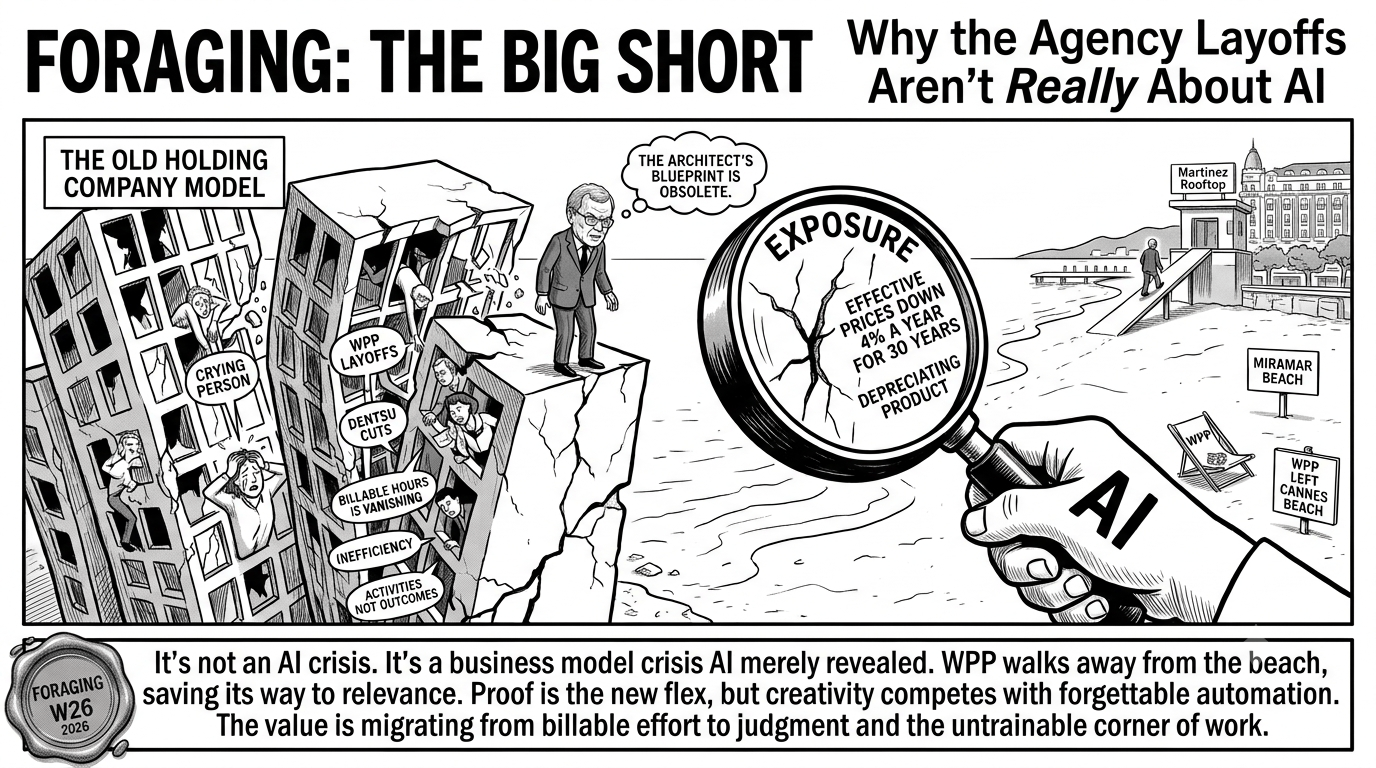
I have been reading the Cannes dispatches all week, the way I read them every June, half for the work and half for the gossip. This year the loudest story on the Croisette was a stretch of sand that no longer belonged to WPP. The holding company, which had held the same prized Miramar beach for years, gave it up. An independent shop, PMG, took the spot and filled it with an AI and tech sandbox. WPP kept a rooftop at the Martinez. The holding companies still own the Palais, the yacht circuit, and the rooms where the winners get picked. But the beach is the kind of detail that tells you where the energy went, and the energy left.
That, more than any keynote, is the story of what AI is doing to this industry. Not a disruption. An exposure.
The layoffs are a lagging indicator
The cuts sweeping the holding companies are the sound of a thirty-year-old product finally being repriced. AI pulled the cover off a model that has been depreciating since the early nineties, and the people losing their seats held the roles that existed to bill the inefficiency.
Lee McCabe, writing from the private-equity side of the table, made the structural case plainly: the holdcos face a business-model crisis that AI merely revealed. What they sold for decades was billable activity, hours and decks and strategy days, rather than measurable outcomes. When a client can produce the same output faster and cheaper, the roles that only ever filled those hours have nothing left to stand on. The scoreboard backs him up. WPP is cutting 9,000 jobs while Publicis added nearly 6,000 people, the difference being that Publicis rebuilt itself around data and identity infrastructure rather than a federation of creative shops. Dentsu and Havas are shedding thousands more under the same "transformation" cover.
The most damning testimony comes from the man who built the model. Martin Sorrell, who assembled the largest holding company in history, now calls the blueprint obsolete. His shorthand for AI's arc is "wow" in 2024, "how" in 2025, "now" in 2026. The billable hour, he says, is vanishing, and a $1.2 trillion industry has to switch from time-and-materials to output and subscription pricing. When the architect of the cathedral tells you the foundation is gone, that is a confession.
The decline has a number, and the number is old. That is what makes it so hard to pin on AI. Alex Brownstein, in a sharp piece written from Cannes, put it on a thirty-year chart: by his reckoning, effective agency prices have fallen about 4% a year for three decades, and the cost of a typical deliverable has collapsed from roughly $435,000 to $110,000. That curve started bending long before anyone shipped a foundation model. AI made the body impossible to keep propped up at the table.
Proof is the new flex
The repricing this industry has been avoiding showed up at the awards this year, in the open. The festival that spent two years celebrating the mere presence of AI quietly changed what it rewards.
Entries fell around 25%, in part because of last year's integrity reckoning, when DDB's Brazilian agency DM9 had a Grand Prix stripped for using AI-generated and manipulated footage in a case-study video for Whirlpool's Consul brand. Cannes responded this year with mandatory AI disclosure, content-detection tools, and an ethics committee. The trade-press framing for the whole week, from Ad Pulse, was blunt: "proof is the new flex." Their sharpest line is the one I keep turning over: "Creativity is no longer competing against AI. It is competing against forgettable automation." Vineet Mehra, Chime's CMO, predicted exactly this going in: AI would be everywhere in the process and invisible in the winners.
I work on this problem, so I'll be transparent: AI content production is the space I build in at Typeface. And the lesson from the festival is the one I keep landing on with marketing teams. The output has stopped being scarce. Anyone can generate the deck, the cutdown, the thirty variants. What is scarce is the judgment about whether any of it moved the business, and that judgment is migrating to a different kind of role.
The performance marketer has already moved outside the machine, and Jonathan Weinstock described the shift better than anyone this week. Google and Meta now handle the targeting and the bidding, and the platforms generate the creative. The human's job is to manage what feeds the system and to judge whether it's optimizing toward the right outcome. As he put it, "the most important input? Your conversion feed and the revenue signals behind it." The platforms pull the levers now. The marketer decides which levers matter.
Even the winner can't shop
The part of this everyone is getting wrong is the assumption that the AI era simply sorts agencies into reinventors and decliners, with the reinventors taking the spoils. Read the week's sources together and a harder conclusion emerges: the value-capture position is leaving the holding-company tier entirely, and even the celebrated survivor may not be the one who wins next.
Publicis is the agency everyone points to as the proof that reinvention works. Brownstein quietly undercuts the victory lap. Publicis already committed its powder, around $2.2 billion for LiveRamp, to buy its data moat, and Omnicom is still digesting the all-stock merger with IPG that made it the industry's biggest holding company. His verdict on the tier is the cleanest sentence written about this all year: "Publicis bought data and it worked. Omnicom bought a competitor and is absorbing it. WPP is saving its way to relevance."
When ad tech goes on sale at compressed multiples, the buyers with cash are the PE-backed mid-market shops. The holdcos already committed their capital to surviving round one, and winning "reinvent or die" leaves you no dry powder for "buy the infrastructure when it's cheap."
There is a layer above all of them that makes even that bet uncertain. Sorrell's quiet observation from Cannes is that the biggest players at the festival now are the tech companies, and that algorithms will increasingly dictate where the $1.2 trillion flows. Nikesh Arora framed the same gravity from the enterprise side in his AI business-model trap thread: the durable value sits in the depth layer, harnesses, context, and memory, the unglamorous substrate the platforms are racing to own. If he and Sorrell are right, a mid-market roll-up buying ad tech may be paying for a moat and getting a bridge, one the platforms are positioned to render moot. The same forcing function is coming for every business that monetized billable effort: law, consulting, the dev shop. The agencies are early because their depreciation curve is the longest and best documented.
I have argued for months that as AI commoditizes execution, the value migrates to the layer a model cannot reach: judgment, permission, the untrainable corner of the work. The agency reckoning is that thesis playing out at industrial scale, with a thirty-year chart attached. The real question on the Croisette this year was about capital. Who still holds it, and whether the thing they would buy with it is a moat or a bridge.
The Odd Find
The Film Grand Prix, the oldest category at Cannes, went to an AI company. Anthropic's first Super Bowl campaign for Claude, made by Mother London, won the festival's most storied prize with two deceptively simple spots, "Can I Get a Six Pack Quickly?" and "How Can I Communicate Better With My Mom?" The joke of the work is that it sells Claude as an ad-free "space to think," contrasting genuine usefulness with the intrusion of commercial interruption.
So the most celebrated piece of advertising in the world this year is an ad arguing against putting ads inside AI, produced by an AI lab, judged by an industry whose entire economy runs on the interruption it mocks. Sam Altman was annoyed enough to call it "deceptive" on X. The festival gave it the trophy anyway.
The holdcos still have the yachts. WPP still has the rooftop. What none of them can answer yet is the question the surrendered beach was asking all week: when the output is free and the proof is the only flex left, what exactly is still being sold here that a machine can't?