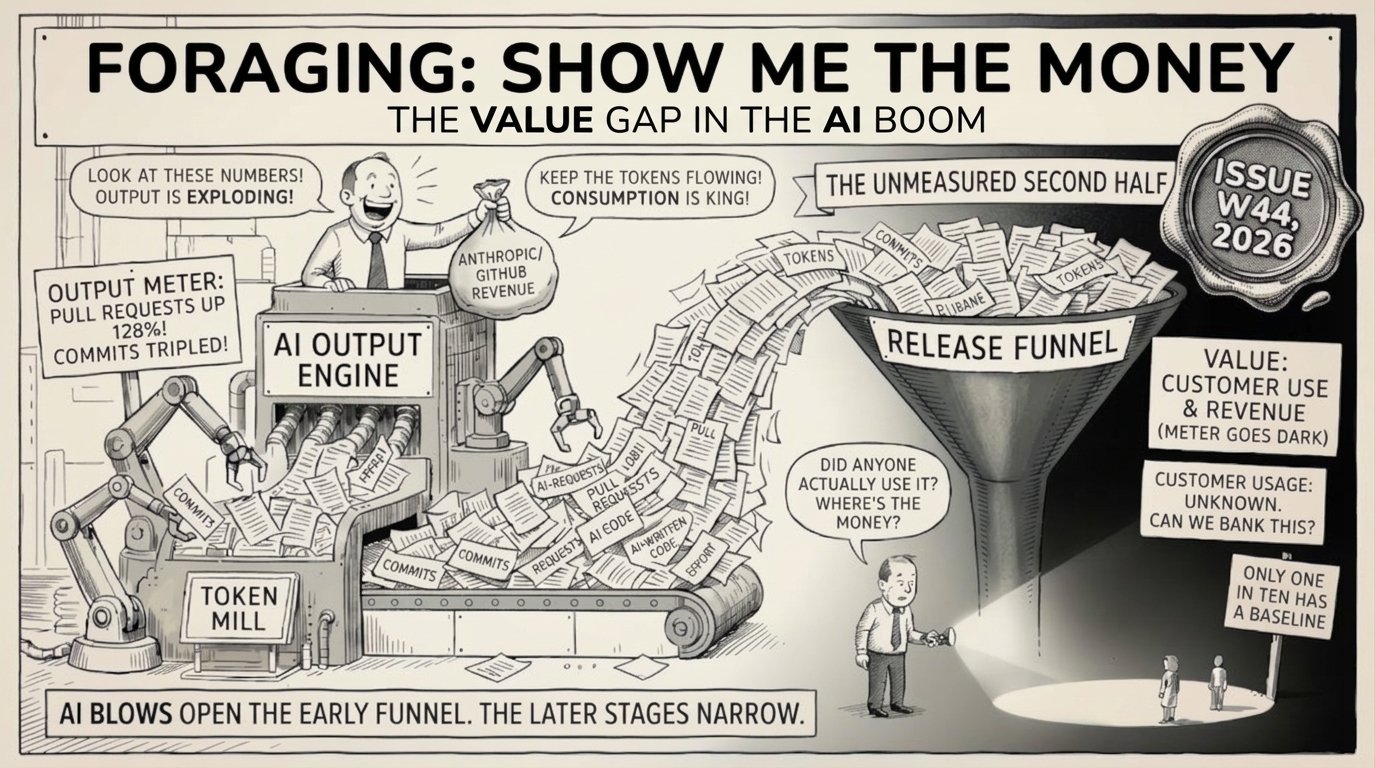
When Anthropic filed to go public last Monday, I read the S-1 looking for one thing: evidence of how the companies paying for AI are getting value from it. The filing is a rare look inside a frontier lab's business. Revenue was $16.3 billion for the first half of 2026, up from $1.2 billion a year earlier.
What I found instead was a split between the producer and the consumer. The S-1 measures what Anthropic produces and sells, and 80% of its revenue is consumption: usage metered in tokens and priced by model. It says little about what its customers got back. Two days later, GitHub's Octoverse showed the same pattern from the developer side: code pushed 17.9 billion times in the past 12 months, more than in 2024 and 2025 combined.
Both count work produced. Neither can tell you whether a customer used any of it, and that's where AI's value turns into money for the company paying for it. AI has made output close to free, and almost every number we report still measures output.
Everyone Is Paid on Output
The meter in this market runs on production. Anthropic is mostly paid per token whether the code it helped write ships, sits in review or gets thrown away, and that's a reasonable way to sell compute. It just means the seller's best numbers say nothing about the buyer's results.
The S-1's headline customer count shows the problem. More than 11,900 customers now pay Anthropic at least $100,000 a year, up from more than 950 twelve months before. That bar is lower than it sounds: at around $200 a developer a month, about 42 engineers on Claude Code clear it, and the filing doesn't separate developers trying things from products running in production.
Net revenue retention is approximately 900%, and model versions released in the previous six months drove over 80% of third-quarter revenue. Customers are subscribing to the frontier and spending more each time it moves. That's proof customers kept paying. A revenue line, a margin or a cost that moved because the AI was there is much harder to find.
Disclosure: I'm President of R&D at Typeface, which builds enterprise marketing software on top of foundation models, so I sit on both sides of this ledger.
The Funnel Nobody Measures
Code goes through a funnel before it's worth anything, and the funnel has two halves. The first half is release: the code gets written, lands in a pull request, merges, and runs in production without breaking. The second half starts after release: a customer uses what got built, and it changes something in their life or their business. AI has blown open the first half, and that's where almost all the measurement sits.
Here's what the evidence shows at each stage of release:
- Written. Commits across GitHub climbed to 34.3 billion, more than three times where they stood two years ago.
- In a pull request. By September, more than 40% of pull requests on GitHub started with an agent's first draft, up from 17% in March. CodeRabbit data in Gergely Orosz's survey of AI spend followed the same 20,211 developers for a year and found they created 128% more pull requests.
- Merged. GitHub's merged pull requests more than tripled to 1.3 billion. Inside individual companies the picture is patchier. At one public SaaS company in Orosz's sample, pull request volume is up, "however, the velocity of PRs merged has not seemed to change much!"
- Running in production. Faros AI's telemetry across 22,000 developers finds that as teams move from low to high AI adoption, the ratio of production incidents to pull requests rises 242.7%, and median time in review rises 441.5%.
Every stage above production is metered, because a tool sits there to count it. Below production the meter goes dark, and that's where the value is. GitHub's own report ends on the same point: "someone still has to decide whether it works, whether it belongs, and whether it's good." The funnel is narrowing at exactly the stages where judgment lives.
Below the Line
After release, the questions change. Did a customer use what got built, and did it change anything for their life or their business? I couldn't find a public dataset that follows AI-written code that far. The closest is a multinational in Orosz's sample that now closes three times more user stories a month, and a closed user story is still a count the team keeps for itself.
The same gap shows up wherever AI does the work, in marketing as much as in code. The first reason the meter goes dark is that almost nobody took a before-picture. A Metric Sherpa study with Sprinklr, written up by MarTech last week, found that 92% of organizations running customer-facing AI say it met or exceeded expectations, and 27% say they can prove it. Only one in ten had defined a metric and recorded a baseline before launch. The study's sharpest point is that "the tool doing the work also gets to decide whether the work succeeded."
The second reason is that the time AI saves gets absorbed before anyone can bank it. Gallup's job-quality study found that 63% of employees who use AI say it helps them do their job faster, and 31% of AI users say their employer has asked them to take on more responsibilities because of it. Faster work that turns into more work is capacity the company absorbed, and it won't show up as revenue per worker.
Back in May I argued that AI productivity has a multiplayer problem: individual gains stay additive until a team shares the governance, brand and data underneath them. A gain nobody measured at the team level can't be banked at the company level.
Add it up across companies and you get Torsten Slok's chart. His Apollo note finds revenue per worker and profit margins rising for the Magnificent Seven and flat for the rest of the S&P 500, and concludes that "the AI story will be decided in the S&P 493, not the Mag 7."
The best case against all this is real. Buyers don't spend nine times as much for nothing, and productivity gains have a habit of showing up inside firms long before they reach an index. Without a baseline, though, most buyers can't tell their CFO how much value they're getting, and the ones who aren't getting it can't tell either.
Growth Is Not Optional
Anthropic's compute commitments are enormous. Elizabeth Lopatto at The Verge totals them at a minimum of around $850 billion over the next 20 years, rising to about a trillion with pending deals. PitchBook's Harrison Rolfes put the consequence plainly: "Growth is not optional for this company. The contracts assume it." The filing is candid about the other side: "We do not expect our revenue will continue to grow at comparable rates, and we cannot assure you that it will continue to grow at all."
That growth has to come from buyers, and buyers who can only see output will eventually manage the bill. Slok says mainstream corporate America is "starting to view token spending not as a source of growth but as a cost center that weighs on margins." On ServiceNow's earnings call last Wednesday, Bill McDermott said the more than 125 CEOs at his latest customer event "all went through the token maxing phase," and he summed up what they learned in five words: "All of the vibe slop flops." Orosz reports that incident.io cut its AI spend from $4,500 per developer per month in August to $1,600 now. On Friday, TechCrunch reported, citing the FT, that Blackstone has told investors in Anthropic's $63 billion chip-financing deal that it now expects a "high" junk rating after the IPO.
So the trillion-dollar bet underneath the S-1 is, in part, a bet that customers learn to measure what happens after the code ships. The buyers who connect AI spend to something a customer did will defend the budget and grow it. The ones who can only count pull requests will treat it as a line item, and line items get cut. For anyone building AI products for enterprises, that puts the measurement layer inside the product, all the way out to the customer.
None of this is an argument against AI. The gap is one of the reasons we chose not to price Typeface on tokens. Customers get value from the use cases they start with, and the bigger gains come from the ones they find next. We want people bringing as many ideas as possible to it. For most AI uses today, the path from a first try to real value isn't a straight line, and a meter that charges for every try makes people stop exploring before they find the next one.
ServiceNow has landed somewhere similar at far larger scale. McDermott told analysts that customers like "the predictability of the seat-based pricing model for their budgeting purposes," and his CFO, Gina Mastantuono, added that customers "are not asking at all for outcome pricing." A predictable price is what lets a budget owner say yes to the tenth idea as easily as the first.
The Odd Find
On Friday, Google said the AI satellite it launched in October had booted its Tensor Processing Units in orbit and sent back its first response. The on-board Gemma 4 model was asked for a haiku about being in space, and it obliged:
“Blue marble below Data streams in silent grace Starlight feeds my core. ✨”
It's part of Project Suncatcher, Google's experiment in putting AI data centers in orbit. The next tests cover thermal stress and radiation, with twin interconnected satellites planned for 2027.
The first thing Google got back from its orbiting AI server was a poem, and nobody is asking for its ROI.
The S-1 counts Anthropic's money down to the customer tier, and GitHub counts code down to the push. The number that will matter more is one neither of them records: what a customer did with any of it.