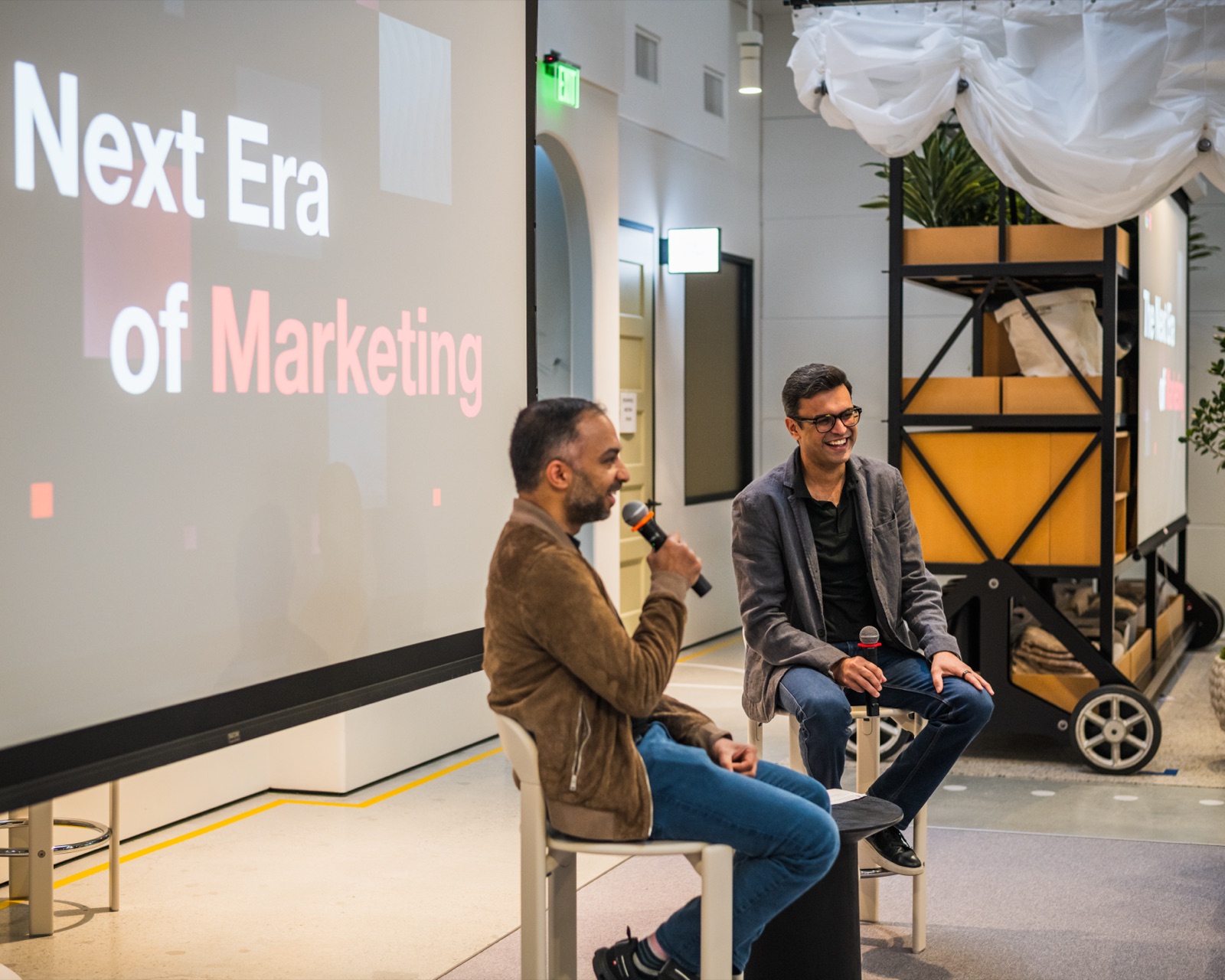
Yesterday morning I sat down with Raviraj Jain, Partner at Lightspeed, at Google's Mountain View campus for a conversation with ~50 marketing leaders. The topic: The Next Era of Marketing.
A few moments that stayed with me.
Raviraj said something I keep coming back to: "We are all managers of agents." Not in the future. Now. When you send a procurement agent to evaluate a vendor's website, that website has to answer questions, not just display pages. CRMs were built for humans. The systems we build next have to be built for agents too.
We talked about the demo-to-production gap. Every morning I open Twitter and see incredible AI demos. But Raviraj has looked at over 200 AI companies at Lightspeed, and his filter is clear: deep system integration, platform architecture, enterprise-grade output. Thin wrappers that prompt a model and return a response don't survive.
I shared something with the room: we recently started tracking Claude Code token usage at Typeface. One of the surprise entries on the list? Our design leader. Coding more than some of our engineers. Raviraj's response: "Engineers are designing. Designers are engineering. Business analysts are pushing code."
That convergence is exciting. It's also why the people piece matters more than the technology.
A lot of enterprises have announced massive AI initiatives. Most of those are headlines, and the gap with reality is huge. The best teams I've seen start with hands-on onboarding, reorganize around what agents can now do, and make sure everyone feels fulfilled through the transition. It may not look flashy, but you've got to have the foundation.
We also talked about what happens when content creation gets 10x faster. You shift the bottleneck from creation to approval. Solve that, and you hit distribution. Then personalization. The real architecture is dynamic content assembly: systems that understand your company, your brand, your governance, and serve content in real time. We call them living surfaces.
Someone in the audience asked the hard question: what about the tension between building for the AI future and maintaining what you already have? Raviraj's answer was a Vanderbilt analogy. Cornelius Vanderbilt sold his shipping empire to go all in on railroads when he saw where the future was headed. "You got to break some things to actually go all in on this." The organizational work is easier to start now than it will be two years from now.
Thank you Raviraj Jain for a conversation I think the room will be thinking about for a while. And thank you to Michael and the Google team for hosting us once again at Mountain View.