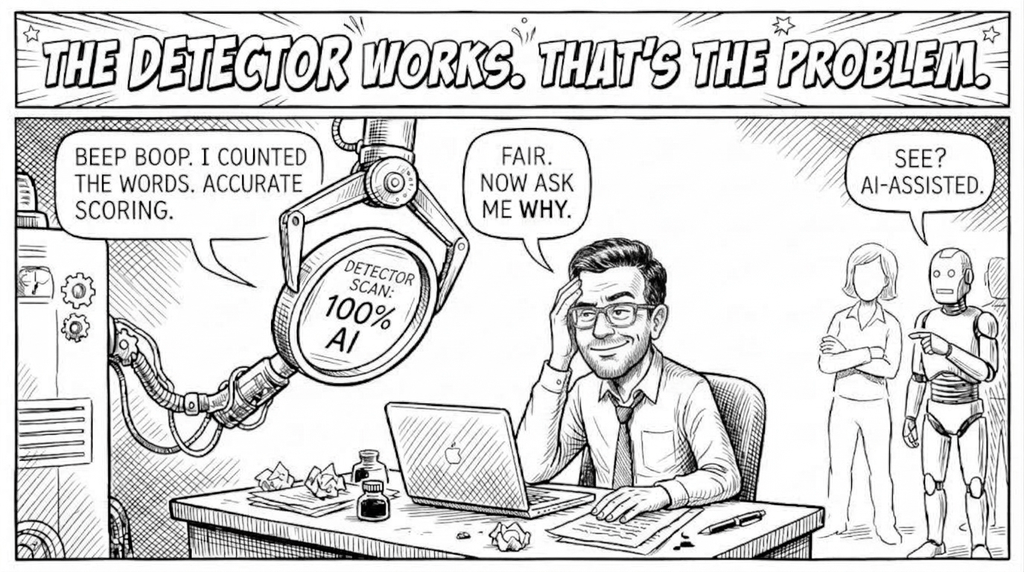
Last week Bloomberg Businessweek wrote about how I write. Issie Lapowsky put the question plainly: "Does most of this writing read like AI? You bet. Does that make it slop?" Bloomberg let me answer the second half. Substack's scanner only answers the first.
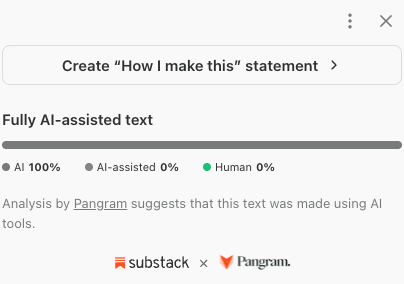
In July, Substack shipped a scanner, built on a detector called Pangram. Any reader can now scan a post of more than a hundred words and see Pangram's breakdown of it: how much is AI, how much is AI-assisted, how much is human. I ran it on my own pieces. This one comes back labeled "Fully AI-assisted text," with the bar at 100% AI and 0% human. Another piece came back at 2% human.
I had spent hours on this one. Those hours went into iterating with the draft, telling it where it had me right and where "this is not how I talk," until my thoughts came through in it.
I build content quality infrastructure at Typeface, so I should say plainly that this is the problem space I work in every day. My first instinct was that the scanner was right, and that it still had no idea what had happened.
The comfortable objection is gone
For about three years, the answer to AI detection was that it doesn't work. False positives were everywhere. Non-native English speakers got flagged as machines because their sentences are cleaner and their vocabulary is narrower. Students failed on the basis of a tool that couldn't be audited. That objection was correct and it was the end of most arguments.
That objection has expired. Detection got good while everyone was still repeating that it couldn't. Nature covered the shift this year, and the independent work backs it. Researchers at Vrije Universiteit Brussel tested four detectors against 160 academic papers and found one that reliably caught both fully machine-written text and text that had been deliberately humanized, at 97.5% and 92.5%. That's an instrument, and it has earned the right to be treated as one.
There's also a version of the sympathetic argument I'm supposed to make and can't. English is my second language, and the strongest case against detectors was always built on people like me getting flagged for writing too cleanly. The Bloomberg piece named English as my biggest barrier to writing, and it's part of the story. The bigger part, as I told Issie, was time.
I can tell a story and I like to write, but writing was never my day job, so it kept losing to things that were. I'm still not sure whether I didn't have the time or just never sat down. Once there's a first draft, I get to work.
So take the number at face value. It's probably right. The question worth asking is what it measured.
What happens before the machine sees anything
Here is my process, and I want to be tedious about it, because the tedium is the argument.
Before there is a draft, I turn on a recorder and talk. I say what the piece is about, the five things I want to land, which customer story proves the third one, where I think I'm wrong, and what order it should go in. That takes twenty minutes and it is the entire act of thinking. There is no model in the room.
The transcript then goes into a system I built for myself, which I call Yara. It holds more than 450 sources, some mine and most written by people whose thinking I want in the room, compiled into more than 90 concept pages. It looks up what I've already argued about the topic, finds the evidence, occasionally tells me that something I'm about to claim contradicts something I've said before, and produces a draft. That draft is 70% there. You'll get 70%, and you'll be lucky.
Then I spend the real time. I score it against a hundred-point rubric I wrote myself, which penalizes the things I don't do: stacking punchy lines one after another after another, making a claim with nothing concrete under it, reaching for a word like "seamless." Nothing goes out below 90.
The scanner sees the output of that last step. It cannot see the twenty minutes at the start, and those twenty minutes are the part that was mine to do.
Building Yara has also made me ask better product questions. The one I keep coming back to is voice. You can't get a model to sound like you by handing it rules. The more you constrain it, the flatter it gets, and a company only sounds like its people if each of them still sounds like themselves.
Yara runs on Claude. Typeface works across models, Claude among them, so what I learn at home carries over to work. Voice is something we're building at Typeface, for brands and for individual authors, and we're our own first customer. Some of what I did by hand for Yara is now part of that work.
Assistance and outsourcing are different acts
A detector reads the wording, which is where voice lives, and it's good at that now. It can't tell you where the thinking came from, because thinking leaves no residue in prose.
And the instrument is about to stop estimating. Anthropic has announced it will start watermarking the text Claude generates, a pattern woven into its word choices that approved checkers can read through a detection API. A watermark trades the estimate for a stamp, and a stamp on my drafts would be telling the truth. Light editing probably won't remove it and a full rewrite will, so what it tracks is how many of the model's words survived. Anthropic's own announcement says it can't tell "Claude wrote this" from "Claude heavily edited this."
The people who build these things know it. One of the rules that scope what Pangram will even attempt is that the model has to have written more than it was given. Hand it more text than it hands back and the content is yours, because the machine added no original ideas.
That's a good rule. It's also one a scanner can't check, because the input never reaches it. This post's transcript ran longer than the draft that came out of it.
So two pieces can score identically and represent opposite acts. In one, someone argued it out in a recording before any model was involved, then pushed it through a dozen rounds of editing. In the other, someone typed "write me eight hundred words on evaluation rubrics," skimmed it, changed the opening sentence, and shipped it.
There is even a label for what I do. Pangram has a middle category, AI-assisted, for writing a person shaped and an AI helped put into words, and the headline on my scan uses it. It's accurate and I would sign it. The bar under that headline still reads 100% AI, the same number the second piece would get. The label is right about me, and the number can't tell you which of us did the thinking.
The strongest case against me comes from Thomas Ptacek, whose rule Simon Willison endorsed in September: you may not use a single word an LLM suggests to you. His reason is that readers can pick out machine phrasing "in the parts per trillion," so the wording is the voice. If the sentences are what you're selling, he's right. In a personal essay, the voice is the product. In most of what gets written at work, the product is the idea.
The test that tells you when detection is right
Detection is legitimate exactly where the reward is for the act of producing. A school exam for English rewards the student's ability to construct an argument under their own power, so a machine-written essay defeats the point of the exercise. A literary prize rewards the writing itself. Peer review rewards the reviewer's judgment, which is why I'd defend the American Association for Cancer Research for asking reviewers whether AI wrote their reports.
Now apply the test to the quarterly business review, the customer summary, the launch email, the internal memo, the post you're reading. At work, writing is how a decision gets communicated, and the decision is what gets judged. The reward is that an idea arrived in your head reasonably intact, and that when you push on it, someone is standing there to answer. Run a detector there and you're scoring a variable nobody was ever paying for.
The Bloomberg piece closed on Scott Stevenson, the CEO of Spellbook, who banned AI-generated client communications and proposals and asked his team for the "D+ version" of their ideas instead, messy and their own. He got there from the reading side, after too many memos that took forever to get through and never landed on a point.
He and I would disagree about the tool and agree about everything else. What he's asking for is the twenty minutes, and the ban goes one step further than it needs to. Banning the tool outright and mandating it with a usage dashboard make the same mistake: both are rules about the tool.
Ownership is a claim, disclosure is a caveat
At Typeface I've landed on a single expectation, and it's older than any of this. You stand behind your work. If some tool wrote the first draft, the mistakes are still yours. Ownership, taste, and judgment are three things you cannot wash your hands of, and none of them are affected by what helped you get there.
The other half is how people get there, and our rule is to push. There are hackathons, leaders demo their own workflows, and when I share something I wrote with AI, I say so, and then nobody feels awkward doing the same. We have never had a dashboard showing who uses AI the most, because the moment you start policing it, people behave around the policing. The bar is whether you own the work and can explain it.
Ownership is also my answer on disclosure. I won't hide how I write. What I won't do is stamp a line at the bottom of every post saying a machine was involved. I don't know what that does for you. It doesn't tell you whether the idea is any good, or whether I checked the numbers.
A disclaimer is something you put at the bottom to limit your exposure. Owning what you wrote is a claim you make at the top, and the second one is worth considerably more.
The part where I agree with the alarm
None of this is a defense of slop, and the volume problem is real. When Pangram ran a million social posts through its own detector this summer, it found that 41% of LinkedIn posts over 250 words were fully machine-generated, the highest share of any platform it studied. That is a bad number.
But look at what's wrong with those posts: nobody was home. There's no argument, nothing concrete, no one who could answer a follow-up question about their own paragraph. The detector catches a lot of them, and it catches them by accident, because slop is usually unedited and unedited text is the easiest kind to spot. It's a smoke alarm that happens to go off during most fires and also every time someone makes toast.
The second risk sits with the writer. In his interview with Jensen Huang, Ezra Klein cited a study from China that tracked 26,000 students through staggered AI adoption. Homework scores went up 18%, and monthly exam scores fell 20% within six months.
The work got better while the person doing it got worse. A detector would flag the homework as machine-written and have nothing to say about the exam.
The honest version of the standard is simpler and harder to game. If I ask you ten questions about what you wrote and you can't answer them, that's the problem, and it was the problem long before any of this.
I wrote earlier this year that human breakthroughs don't show up on dashboards, that the meters capture motion while the judgment that turns motion into anything worth having stays invisible to them. The detector is the same kind of instrument, a dashboard pointed at a page. It counts something real, reports it accurately, and misses whether a person was thinking when this was made and whether they'll stand behind it now.
AI will 10x anyone, maybe even 100x. It'll do it for the person who's good, and it'll do it for the person who isn't, which is why the sorting is getting so much more visible so much faster. AI can raise the floor for everyone. The ceiling is still yours.
The fourth piece in The Human Premium.