Last week we had a company offsite, and one of our engineering leaders raised an account they were worried about. The work was solid and adoption still wasn't where it should have been. So we spent a while on it, going through where things were working and where they weren't, and then contrasting it with some other accounts. By the end we were looking at a consistent pattern around how three roles played a part in getting the desired adoption. Sharing that here.
I keep saying that in enterprise AI the technology is the easier part, and that people and process are what actually decide whether anything gets used. I believe it. It is also the kind of sentence that lets you off the hook, because the honest follow-up question is the harder one. Which people?
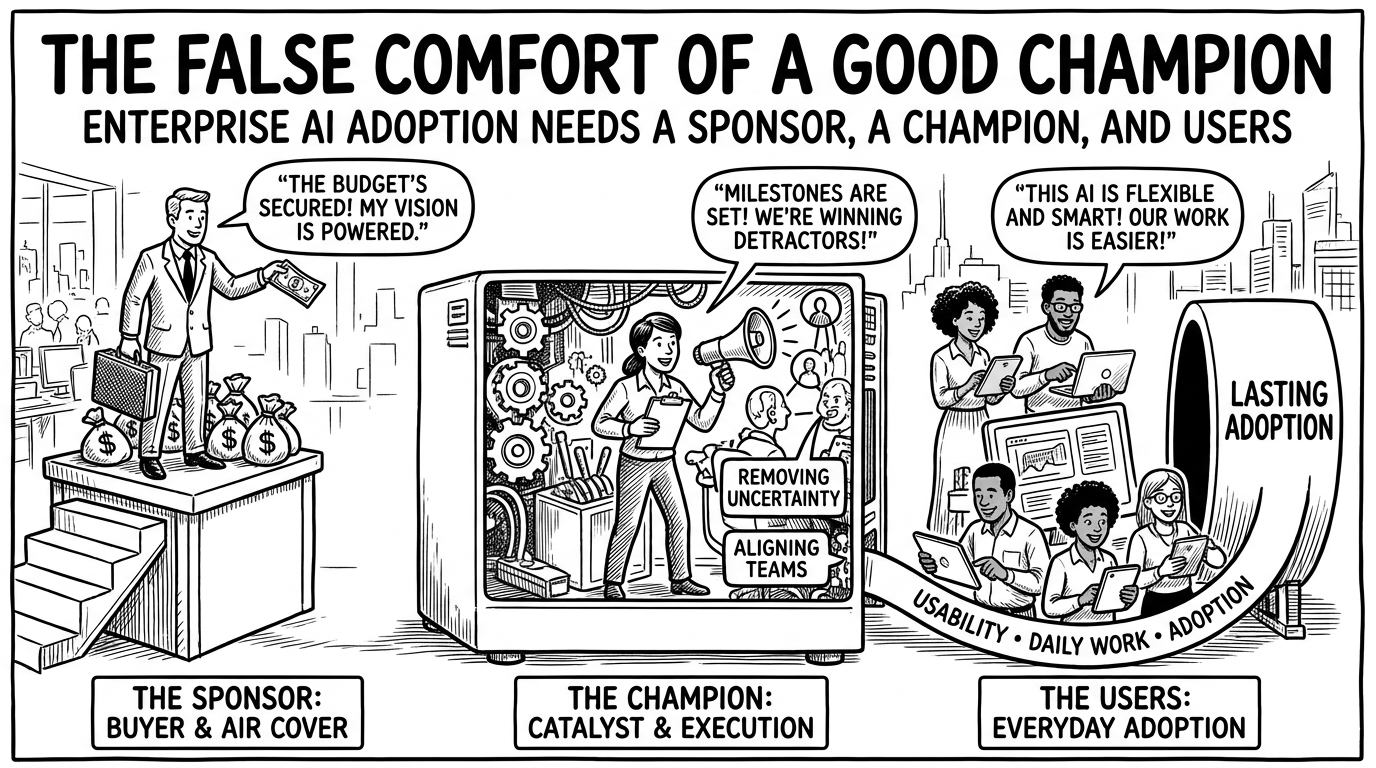
There are three roles inside a large company that decide whether your product gets adopted: a sponsor, a champion, and a set of real users. You need all three, and the thing I want to write about is what happens when you have two, because two is the situation that has fooled us more than once. If you've sold enterprise software, the first two will be familiar, because every deal framework has some version of an economic buyer and a champion. The third one keeps moving: it is never one person, and the group changes as adoption matures, so each wave arrives with different expectations from the one before it. And missing is not the only way to lose: a role that is present but inactive breaks it the same way.
We were working with a large financial institution. We were close with the champion, closer than usual, and everything was green for months. Then the users came into the room and told us the thing felt rigid, and that this wasn't what AI had promised them. Integrations, architecture, how any of it had been built: none of that came up once.
The uncomfortable part is that they were right, and that we had walked into it together. We and the customer had spent months making the experience work end to end and making the governance hold, and both of those were the correct things to be doing. Neither of us had stepped back to ask whether the result would feel flexible to someone who spends their evenings with frontier consumer tools. It took the users to say it out loud, and by then it was in the product.
That is the false comfort. You have someone paying, you have someone engaged, and it feels like full coverage when one of the three seats is empty. So you can't leave adoption alone and let the account run itself. You have to get involved inside these companies, and being involved means knowing what each of these three roles is for.
The sponsor is the buyer
The sponsor's main job is simple. They hold the budget and they're putting their dollars to work. Everything else about the role depends on where they sit.
If the sponsor is also the business owner, their job is to give the team air cover, and to make sure the team is bought in and set up to succeed, both in how it's structured and in how it's incentivized. This is the linchpin. If it doesn't hold, nothing downstream holds either. There is no amount of product quality that survives a business owner who funded something and then went quiet.
From our side, when the sponsor is the business owner, the work is unglamorous and continuous. How do you keep them excited, and how do you celebrate the small wins early enough that they have something to point at in front of their own leadership? The rest of it is maintenance. A channel that's always open instead of a monthly slide, updates that arrive before they're asked for, and enough time sitting with them to understand the nuances of what they're dealing with in their business. Sometimes it extends to advising them on how to make this project succeed inside their own organization, which feels like overreach right up until you've watched a good project die of nothing in particular.
The second case is a central innovation team or a central AI team, and here your job gets harder. Their mandate is to evangelize whatever innovation project they're driving, and it runs until a real business owner is looped in. This is a temporary sponsor by design, and if you treat them like a permanent one you'll find out in the next budget cycle. Central innovation efforts stall when nobody downstream picks them up, so your goal is to use their help as the medium to find the real sponsor.
Which means delivering what they asked for is the floor. You have to ideate with them, bring them ten ideas they didn't ask for, and arm them with the right demos, the right updates, the right sizzle to carry into rooms you'll never be in. Good teams doing AI work carry a barrage of ideas.
We are doing this right now with a CPG company. Once the foundation was solid, we asked our team to run a hackathon and come up with ten different ideas for what the capability we built could be pointed at. The logic is not clever. If the first one doesn't stick, maybe the second one does. And if none of them stick individually, all of them together might.
Plenty can still go wrong here and most of it is outside the scope of this piece. You can lose your sponsor. There can be a reorg, or a central innovation budget that evaporates between two quarters. These are high-likelihood events, and the place for them is your plan, months before they show up in a retro. What contingency you build depends on the situation you're in, and that's a deeper topic than I want to open here.
The champion is the catalyst
The sponsor is usually senior, a VP or an executive, and they won't have the day-to-day time to rally the troops or to take their own vision and spell it out cleanly for the execution teams on both sides. So the role falls to someone on their team who subscribes to that vision, takes it, breaks it down into a plan, and drives the goals the engagement was set up to hit.
If the sponsor is the evangelist, this person is the catalyst, and without a catalyst the project doesn't reach a success state either. This is the person who knows the nitty gritty of the organization: what motivates it, what moves it, how to manage air cover with the exec, and who the detractors are before they say anything out loud. You can embed as many of your own people inside a customer as you want and you still won't get that signal at high fidelity. It has to come from inside.
Supporting them well is mostly about removing uncertainty. If you're the AI platform or the AI team on the other side of the table, make no mistake, it's your job to make sure there's a clear project plan, real milestones, and success criteria defined well enough to argue about. If you're lucky you'll get a champion who pushes you hard. If you're not, you need to manufacture your own sense of urgency, because the odds of an AI project succeeding inside an enterprise of this size are low, and they're low because of the sheer number of moving pieces. Every piece of uncertainty you can take off the board is a point of margin.
The milestone people forget is the one that matters most. Delivery is not the finish line. How will the champion make sure the thing you delivered actually gets used to produce an outcome, and an ROI the business recognizes as its own? Value attainment needs dates on it the same way delivery does. And you need someone on your side whose job is to push, or to complement the push coming from the champion, so that the contract runs in both directions.
Then there's the blind spot, and it's a structural one. The champion usually has a day job of their own. As an example, if your sponsor sits in marketing or in innovation, your champion may well sit in IT, where the real job is building tooling for the organization. They will bring their own set of biases into the work, and they will do it while being completely well intentioned. I don't want to call it an agenda, but there's usually an agenda. The worse version is subtler: a champion with great relationships and genuine goodwill who doesn't do a marketer's job and therefore doesn't know what a marketer's day costs them.
There is a sharper version of this, and it involves no bias at all: you and the champion build the blind spot together, because you're both pulling hard in the same direction and the direction is correct. At the financial institution we were both optimizing for coverage end to end and for governance that would survive an audit. Two competent parties, aligned, months of green. The thing nobody was measuring was whether any of it felt good to use. Everyone in the room was telling the truth as they understood it.
The user is where the rubber meets the road
It is great to have a sponsor willing to pay for a business outcome. It is great to have a champion who does the daily work of making it happen. Adoption is the moment a user is happy and gets to an outcome, and this is the hardest part of the job.
Go back to those users at the financial institution. Rigid was the word, and the framing underneath it was almost exactly this: I can already do so many things with the tools in my personal life, so why does my work life feel like less? The concrete version of the complaint is sharper. I can go to the Lovables of the world and spin up any number of HTML pages this afternoon, so why are you limiting me to a template at work? We ended up solving this but that's another story.
Everybody has now seen the magic that AI promises. Nobody outside our world understands the difference between a single-player system and a multiplayer one, or why governance changes the shape of the product. They want all of that to disappear, and they want the flexibility of frontier consumer tools while it does. That is the bar they arrive with now, and it moved a good deal faster than most enterprise roadmaps did.
The second failure mode is quieter and I think more common. A beverage maker we work with loves the tool. It's clearly adding value. But it's not a thing they do every day, so recall on it is low, and a tool nobody remembers is indistinguishable from a tool nobody wanted. This is exactly where the ten-ideas move earns its keep.
What we built for that company is effectively a second brain. It understands their brand deeply, and their marketing strategies with it. Once you have a brain like that in the building, the surface area is enormous. It doesn't have to stop at evaluating whether something is on brand, or ideating within the brand. It can explore new directions for the brand, read the analytics, do content intelligence.
You find those use cases by sitting with the people who have the job, watching how a day goes, bringing them what you've built or plan to build, and pushing past the obvious cases you arrived with. It is field work, and it takes the kind of time that never survives a quarterly plan.
Then you have to marry that flexibility to everything the enterprise can't give up: the governance, the second brain for the company, and the multiplayer setup where a group of people can work together. That last one is the thing I wrote about in May, and it's what the market still keeps solving one seat at a time.
Anyone can go to Claude Code and write themselves a skill. While it works for them, it doesn't work for the team, because it isn't designed for multiplayer. What we're building are production-grade systems that hold governance and shared context underneath and still feel, at the surface, like working with a good coworker. Make the constraints transparent in daily use and legible when someone goes looking for them, and that's where it starts to move.
Getting all three dialed in
So, three roles. The sponsor is the buyer, bringing the dollars and the exec air cover the team needs in order to do anything at all. The champion is the catalyst, running the day-to-day, identifying who the detractors and the evangelists are, getting them aligned, breaking ties, and formulating the approaches that need several people to cooperate. They push you, you push them, and the contract between you is explicit. The user is the one who opens it on a Tuesday, and the more of their real use cases you can find, the more often they come back to it, and the more of the multiplayer and governance machinery you can run underneath without making them carry it.
I would not call this magic. It's closer to a formula, and the difficulty isn't in any one term. You can get one of these dialed in most of the time. Two happens more often than you'd think, and two is precisely what a green status report looks like from the outside. All three at once is rarer, and it's the only configuration I've seen where adoption actually holds.