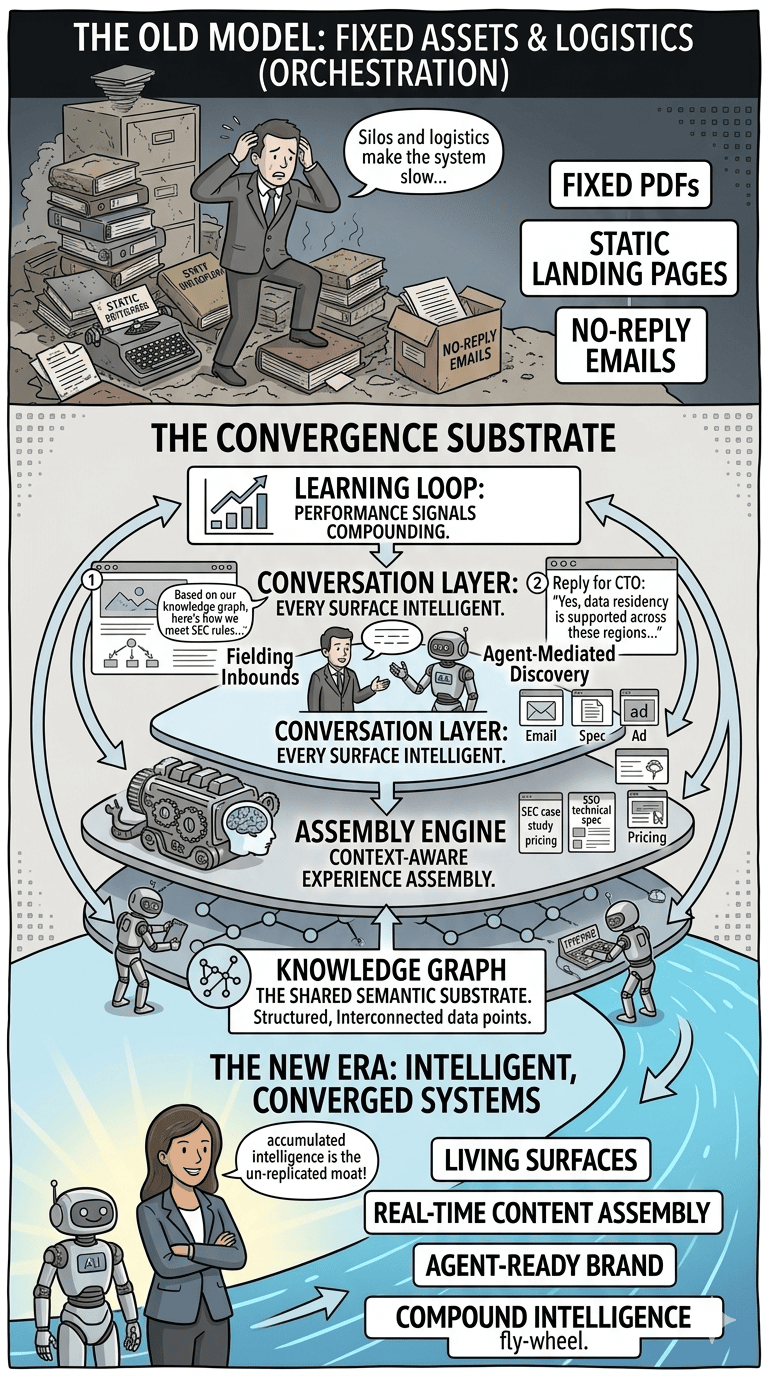
For twenty years, the model was: create content, place it in a channel, measure what happens. AI made creation 10x faster, and most organizations poured that speed into the same playbook. More variants, more templates, more campaigns. The assembly line got faster. The architecture stayed the same.
The constraint that justified fixed assets is gone. The playbook built around it hasn't caught up.
The piece introduces what I'm calling Convergence: a system where channels share a common substrate and the intelligence from one interaction improves the next. Orchestration coordinates more. Convergence learns.
The practical version:
→ A proof point that converts in paid media automatically reshapes landing pages and emails for the same audience.
→ An email fielding a reply draws on the same knowledge graph that composed the message.
→ A landing page that didn't exist before a visitor arrived assembles itself from structured brand knowledge, calibrated to their role, their industry, their evaluation criteria.
What one channel learns, every channel applies by morning. In most organizations, that intelligence waits for a Monday standup. Convergence closes that gap.
The piece covers four load-bearing layers of the architecture, four early signs already in production (Meta made its entire ad platform queryable by AI agents, Google open-sourced DESIGN.md for machine-readable brand identity), and what makes it genuinely hard: brand governance at assembly scale, closing the measurement loop, and the org chart.
Full disclosure: this is the problem space we work on at Typeface. This is what I'm seeing across customers and the broader market.
Full piece is on Substack. Link in comments.