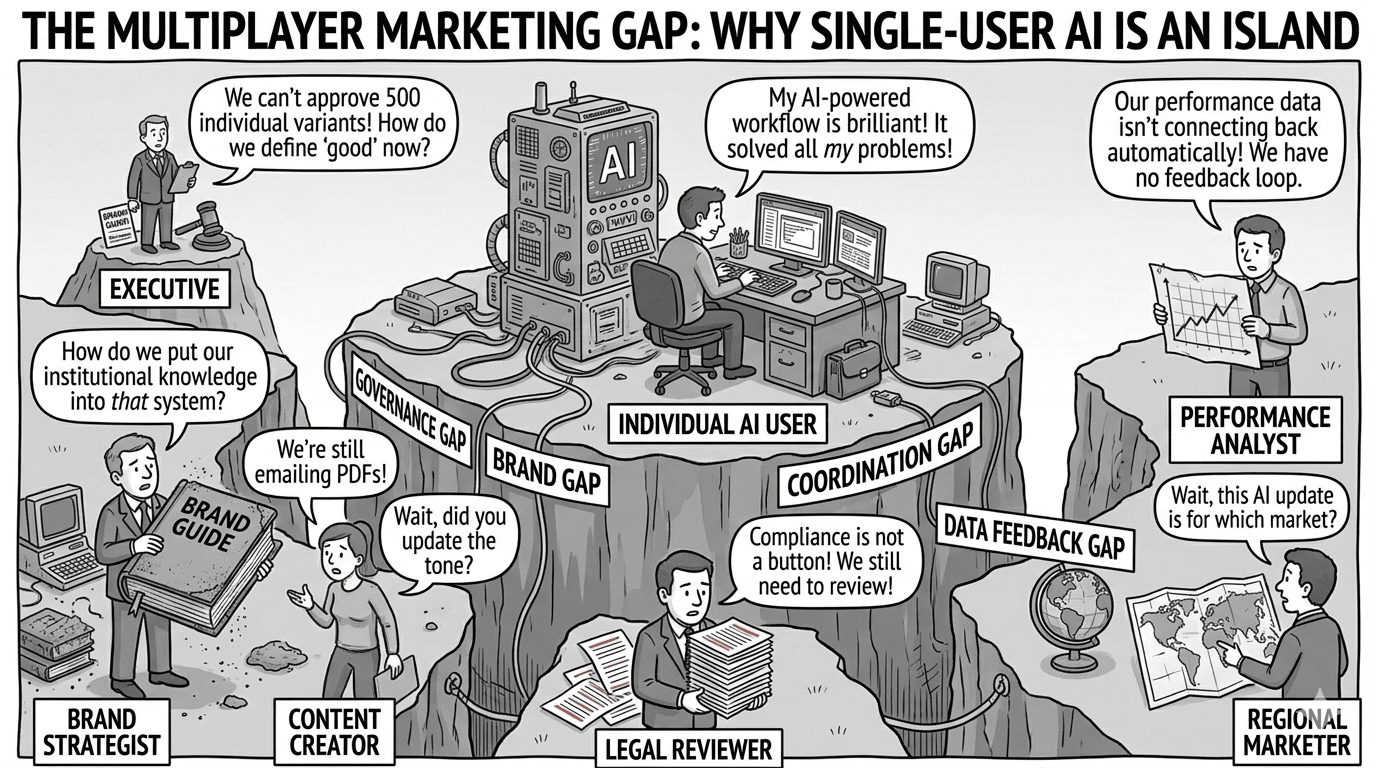
A developer I know recently rebuilt her entire content workflow in a weekend. Claude Code with a handful of custom skills: one for drafting, one for SEO analysis, one for scheduling. She showed it off on LinkedIn and got hundreds of likes. The setup was impressive. Thin harness, fat skills. One person, one machine, end-to-end content production in minutes.
Then she tried to hand it off to her marketing team.
The brand team couldn't enforce their guidelines through it. The legal reviewer had no way to flag compliance issues inside the workflow. Regional marketers in four countries needed localized versions but had no access to the prompts or the context that made the originals good. Performance data from the campaigns lived in three different dashboards that the system couldn't read. Within a week, her solo workflow was running alongside the old process, not replacing it. Double the coordination overhead, and a growing resentment from the team that felt left behind.
If you've been the person who got faster with AI while your team stayed at the same speed, you know what comes next. The guilt of individual productivity that doesn't scale. The frustration of seeing so much potential and wondering why no one else is moving yet. The growing distance between what you can do alone and what the organization can absorb. The moment you realize your 10x workflow is making everyone else's job harder, not easier.
This pattern reveals something the current AI conversation is getting wrong.
The single-player trap
The solo operator has never had better tooling. Claude Code has a growing ecosystem of community-built skills. ChatGPT has its custom GPT marketplace. Every week brings a new framework that promises to let one person do the work of ten. Thin harness, fat skills has become the mantra: keep the orchestration layer light, let specialized skills do the heavy lifting.
The results are real. Marketing teams see engineering success stories and want the same thing: Intercom doubling merged PRs per R&D employee with 100+ custom skills, Ramp's 800 builders shipping 1,500+ apps in six weeks.
But here is what gets missed in the retelling. Intercom and Ramp succeeded because they built shared infrastructure first. Intercom created a custom skills repository with 100+ skills encoding their engineering standards, enforced through automated hooks. Ramp built Glass, a workspace that auto-configures with 30+ connected systems on install, and Dojo, a marketplace where anyone can package a workflow and share it. The individual productivity was real. It was built on top of multiplayer infrastructure. Marketing teams copying the single-player playbook without that foundation are skipping the part that made it work.
This pattern keeps surfacing in conversations with marketing leaders. They can point to individual team members doing impressive things with AI. What they can't point to is those individual gains adding up to organizational capability. The 5x super-user leaves for another job and takes all of it with them. No institutional learning was created. Ann Miura-Ko calls this being stuck at L1 in her AI maturity framework: individual productivity without organizational learning. "80% of employees use AI weekly!" is, in her framing, "probably true and also meaningless."
The deeper issue is structural.
Marketing is multiplayer. Multiplayer means shared context, shared governance, and shared learning loops across roles. And almost every tool being built treats it as single-player.
What multiplayer means
In Typeface Signals, 61% of marketers use AI at the individual level, not on collaborative platforms. Of the marketers who report using AI, 82% remain stuck in pilot phases. Those two numbers are connected.
Marketing is one of the most multiplayer functions in any company. A single campaign might involve a brand strategist setting guardrails, a content creator drafting assets, a regional marketer adapting for local markets, a legal reviewer checking compliance, a performance analyst measuring results, and an executive approving the spend. Each of these people has different context and different definitions of "good."
When one person builds a brilliant AI workflow on their laptop, it solves for exactly one of those seats. The other five are still emailing PDFs.
This is the list of things that individual AI tools do not touch:
- Governance. Who approves what, and what does "approved" mean when the AI generates 500 variants instead of 5?
- Brand. How do you encode institutional knowledge about voice and positioning into a system, rather than relying on one person who "just knows"?
- Coordination. How do you move work across teams when every team has different AI setups and different skill levels?
- Performance data. How does what you learn from one campaign feed back into the next one, automatically, across the whole organization?
These are multiplayer problems. Each one requires multiple people with different roles to agree on how it works. And that agreement is harder than the technology.
Why most deployments don't compound
How you design the system matters more than the tools you give each person. Microsoft's research across 20,000 workers confirmed this: organizational factors account for twice the AI impact of individual factors. And yet almost all the energy in the market is going into the individual tooling layer.
Most AI tool deployments today deliver additive returns. Ten individuals each get 2x more productive, the organization gets 2x output. Every person's gain stays in their own workflow.
Compounding returns look different. Ten individuals learn and share through a common system, and the organization gets 5x, then 10x, because every discovery feeds every other person's work. This is what Ramp understood when they built Glass. The insight wasn't the tools. It was the distribution mechanic: when one person discovered a better workflow, everyone got it automatically. No memo, no training session. Individual learning became team capability.
Most marketing organizations are stuck on the additive curve. In our research at Typeface, 48% of marketing leaders cite cultural resistance as a top barrier. A Workplace Intelligence survey found that 29% of employees actively sabotage AI strategies they don't trust. Shadow tools create data breaches. These are coordination and governance problems at their core, and they get solved by building multiplayer infrastructure that makes the right thing easier than the wrong thing. That infrastructure shows up at every layer of how a marketing organization operates.
Every layer has a single-player mode and a multiplayer mode
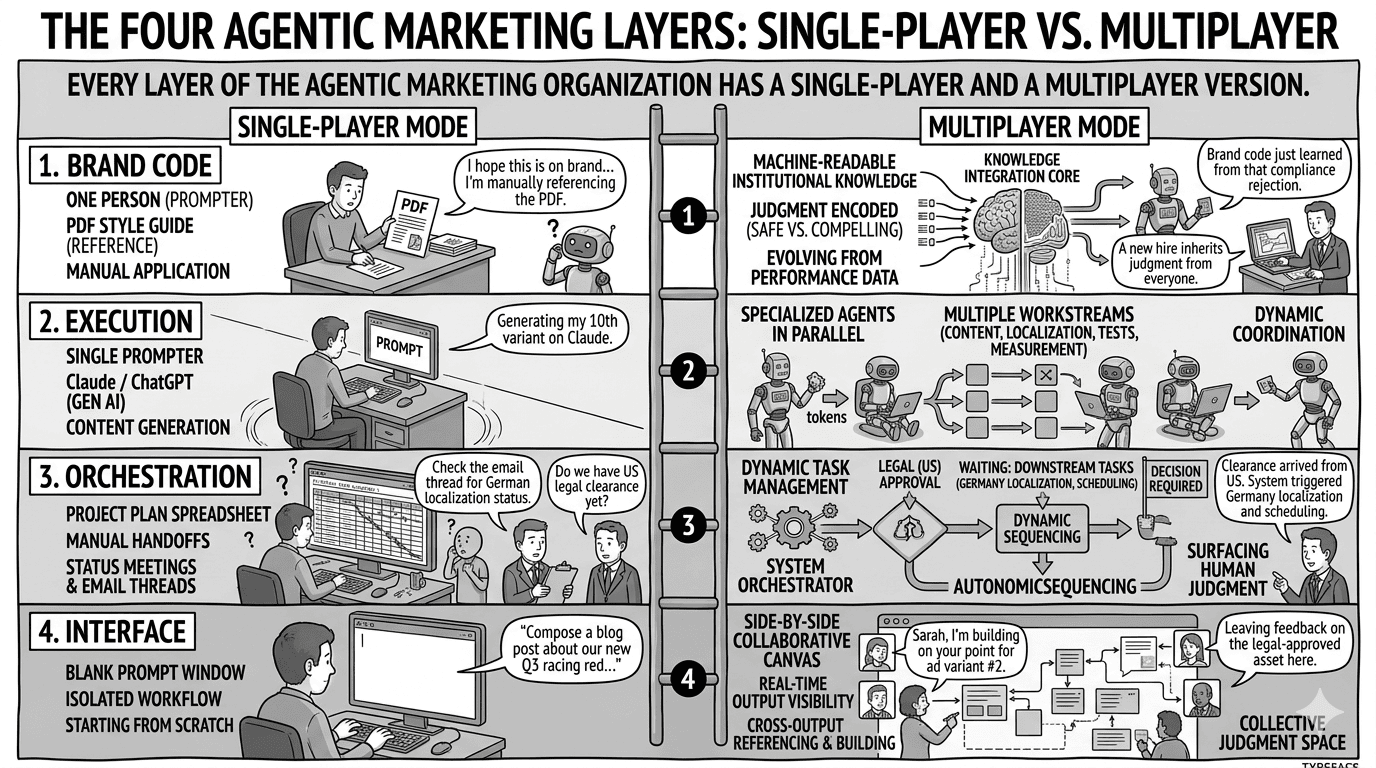
Every marketing organization runs on four layers: brand code, execution, orchestration, and interface. Michelle Taite, John Winsor, and Will Fernandez laid this out in HBR recently, and what struck me reading it is that every one of those layers has a single-player version and a multiplayer version. Most teams are running single-player on all four.
Brand code in single-player mode is a style guide PDF that one person references while prompting. In multiplayer mode, it's machine-readable institutional knowledge that every agent and every workflow draws from automatically. It encodes how your brand makes decisions, how it distinguishes between "safely on brand" and "compellingly on brand," and it evolves: when a campaign performs well, that signal feeds back into the brand code. When a compliance reviewer rejects an asset, the knowledge base learns to avoid the same mistake across every future asset, in every market. A new hire should inherit the accumulated judgment of everyone who came before them, not start from scratch with a blank prompt.
Execution in single-player mode is one person generating content with Claude or ChatGPT. In multiplayer mode, it's specialized agents handling generation and localization in parallel, with testing woven into each step. The developer in my opening scene had this nailed for one person. The multiplayer version runs the same workstreams across teams and markets simultaneously.
Orchestration is what connects those workstreams. In single-player mode, it's a project plan in a spreadsheet. In multiplayer mode, the system manages dependencies and triggers the next action dynamically. When a regional launch in Germany depends on legal approval from the US team, the system holds the queue until clearance arrives, then kicks off localization automatically.
Interface in single-player mode is a prompt window. In multiplayer mode, it's a collaborative canvas where multiple people work side by side, see each other's outputs in real time, and build on them without switching tools. The interface becomes the place where the team's collective judgment lives.
Marketing organizations need all four layers operating in multiplayer mode. That's what we work on at Typeface, so I should be transparent about my perspective here. But the pattern is not vendor-specific. It shows up everywhere that AI moves from demos to production: the individual workflow that wowed a conference room doesn't survive contact with 200 people who need to coordinate around it.
If you're the person who built the solo workflow, the next move is becoming the person who can wire individual capability into organizational infrastructure. That's a different skill than prompting well, and a more valuable one. The marketer who can do both, build fast individually and design systems that let the team compound, is the one every organization is about to need and almost none have yet.
Back to the developer
The developer from the opening of this piece figured it out. She didn't abandon her Claude Code setup. She embedded it inside a system that her team could use. The brand team got guardrails that enforced guidelines without touching the prompts. The legal reviewer got a compliance gate that surfaced flagged content before it shipped. The regional marketers got localized templates with the context baked in. The performance data connected.
Her individual productivity didn't decrease. But the organizational capability around it changed. The system started learning from every campaign and every approval. New team members onboarded in days instead of weeks. The resentment faded, because people weren't being left behind. They were being brought in.
That transition, from single-player to multiplayer, is the whole game now. The technology isn't the bottleneck. The design problem is how you make the collective brain compound.