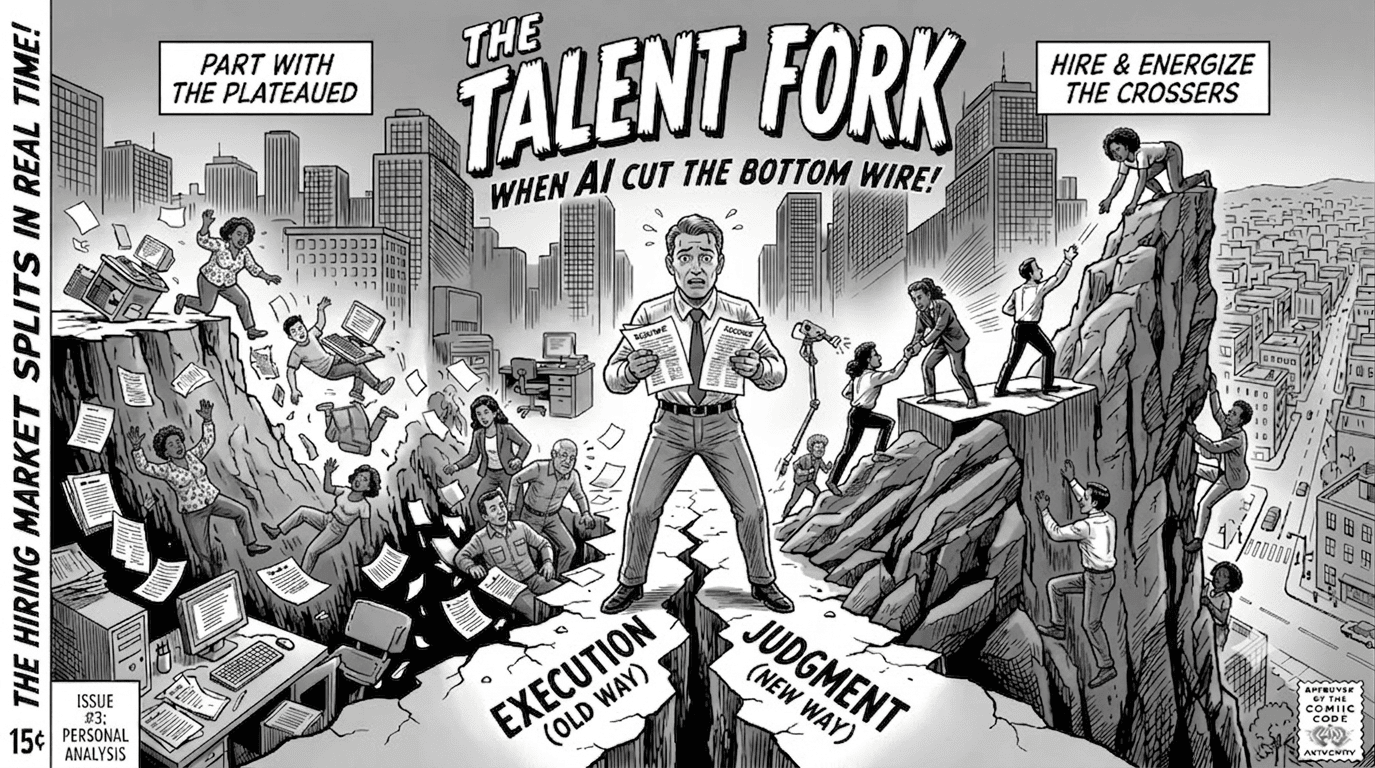
Every hire is a bet you place through proxies. You cannot see whether someone has judgment, so you infer it: the logo vouches for the execution, the execution vouches for the judgment underneath. For most of the last decade that chain held, because only people with judgment ever accumulated the trail: the shipped work, the good logos, the clean climb. You could read the résumé and trust the inference. Execution was scarce and expensive, so proof that you could execute was proof enough of the thing beneath it.
AI cut the bottom wire. Execution is free now, so it proves nothing. Every candidate's demo works. Every prototype runs. The chain that let you infer judgment from output has come apart in your hands, and if you run a team you can feel it before you can name it: the signals you trusted have gone quiet, and you are not sure what to read instead.
This is the third essay in a series, and it is where the argument stops being analysis and gets personal, because it moves from the market to the people in your org chart. I started by claiming that no dashboard can see whether AI made the work better. Then I argued that judgment is the scarce asset now that production is free, and that taste has to be built as infrastructure, since no hire brings it ready-made. Talent is what happens when a leader has to act on that repricing while people are mid-career and mid-mortgage. All three moves that follow once relied on the same proxy: execution. That proxy is gone, and most orgs are still wired as if it were not. The moves are simple to name and hard to make: who you hire, who you energize, and who you part with.
Hire: for judgment the résumé can't prove
The résumé was always a proxy for execution. Execution is free. So the résumé is now noise, and the fastest way to see what replaces it is to watch the companies rebuilding hiring from the studs. Their revealed behavior tells you, more honestly than any manifesto, what they are now willing to pay for.
Three of them have each rebuilt a different part of the funnel.
Ramp rebuilt who gets in the room. Half the PMs it has hired in the last two years are ex-founders. That is a deliberate filter. The company screens for people who have owned a call end to end, with no one above them to escalate to. Its CPO, Geoff Charles, puts the endpoint plainly: "management is probably dead; be the best builder in the world." The interview follows the philosophy. PM candidates build a working prototype, where the old interview asked for a slide deck.
Sierra rebuilt how you test. It scrapped its coding and algorithm rounds and replaced them with three phases: plan, build, review. The candidate is handed a real, underspecified product problem, given two hours and any AI tools they want, and told to make something. Then they sit in a review and defend it: the data model, the abstractions, the calls they got right, the ones they would redo. The coding phone screen became system design, because, as the team put it, vibe-coding an app is easy now; the hard and relevant problem is getting it into production at scale. The most telling change is in what the debriefs ask. The question became "where would this person thrive," a hunt for a specific strength, replacing the older "should we hire this person," a hunt for the absence of weakness. You do not redesign an interview that way unless you have decided the scarce quality is judgment rather than competence.
At Typeface, we moved the work sample ahead of the interview, and the bar has climbed in real time. An assignment that was strong a year ago would not make the cut today. Execution is table stakes now; the model does that part. What we read is the thinking: the judgment calls, the tradeoffs someone defended, whether they carried the problem across a full end-to-end path or stopped at the happy case. When I interview now, my first question is how someone decided what to build. What they built is answerable by anyone with the tools. How they decided separates the room.
Three companies, three layers of the same funnel: who is in the room, what you ask them, what you grade. All of it redesigned to surface the one thing output no longer reveals. The through-line is simple once you say it. When execution is free, the signal lives entirely in the decisions around the artifact. So you build the whole process to make those decisions visible.
Energize: turn the crossers into catalysts
Hiring for judgment gets you the raw material. It does not get you an organization. The instinct at that point, to train everyone up and run the workshops, is the wrong read of how the change moves.
I watched the real mechanism inside my own team, and it is the reason this series exists. We handed the same tools to everyone. A few people crossed some threshold the others didn't, and for that few there was no going back. They became the ones who challenge whatever the current solution is and keep dragging the rest of us forward. What set them apart was one thing: whether they brought judgment to it, whether they showed up with a real problem and wanted a genuinely better answer instead of a faster version of the old one. The token counts and the fluency of their explanations had nothing to do with it.
That is the move most leaders miss. Most of them try to level the whole organization at once. The move that works is narrower: find the handful who cross, give them a stage, and let them pull the rest up behind them.
Ramp is the operational proof at scale. Its adoption came from an L0-to-L3 ladder, a company leaderboard, and a deliberate policy of putting the early converts on stage. "Give people a stage, not just a mandate," is how Charles describes it, and the competitive pull did the work: nobody wants to be the team that isn't building anything. The catalysts became the contagion. Zapier encodes the same principle into its rubric with a sharper phrase. It now scores AI fluency as a slope rather than a snapshot, so forward momentum outranks current skill. You invest in the person who is still climbing, and you stop subsidizing the one who has plateaued at impressive.
Energizing a team is not a training problem. It is a casting problem. Find the people already climbing, make them visible, and let the slope do the rest.
Part with: the people not ready to cross
Then there is the move the cheerful version of this conversation skips.
Not everyone crosses, and the reason is the part leaders get wrong. Nikhyl Singhal, who has run product at Google and Meta, calls the line people have to cross a "reinvention threshold," and he is emphatic that it is psychological before it is technical. The hard part is letting go of an identity built around being the person who could execute, the one whose value was legible and certified by a logo. He describes the ambient condition in the profession right now as "smiling exhaustion": widespread burnout masked by performative optimism, people publicly embracing the transition while it quietly grinds them down. That exhaustion is the sound of people sensing the fork without being able to cross it.
The leadership part is uncomfortable. Some of your best people, by the old measure, will not make the crossing. The blocker is rarely ability. Crossing means surrendering the exact thing that made them valuable, and not everyone will pay that price. Keeping them in a role the ground has moved out from under is the cruelest option dressed as the kind one. It is a slower version of the same outcome with the honesty removed, and it costs the person the one thing they can least afford to lose: the time to reinvent somewhere the reinvention is still welcome.
The companies furthest along say this out loud. Ramp attaches consequences to its ladder, where sitting at L0 implies departure risk. Zapier's floor moved so that "capable," meaning someone who can use the tools, is no longer hireable. Standing on the old floor has become a decision in itself. Singhal attaches the number that makes it concrete: companies, he predicts, will shed 30,000 people and rehire 8,000, all AI-first. Run the arithmetic and it is a 73% net cut with a different population walking back through the door. The replacements are mostly not the incumbents who took a workshop and updated their tooling. This is the part-with move at market scale, and it is already underway, in public, faster than most résumés can keep up.
Parting with people well is its own discipline. Done as denial, it is the layoff nobody saw coming. Done as leadership, it is honesty early enough that the person still has runway to build toward the other branch.
The fork is the same line, drawn through people
Notice that all three moves sort along a single axis. On one side is the work that is legible: executable, benchmarkable, the kind of task with a public right answer. On the other is the work that is illegible: judgment, taste, the call that resists being written down as a rule. Sarah Guo's framing is that anything you can measure cleanly is something a model can eventually be trained against, so durable value collects in the work whose correctness can't be measured from the outside. That was a thesis about where AI value lives. It turns out to be a map of the labor market too, and the operating manual for running a team through it. Hire toward the illegible half. Energize the people who have crossed into it. Part with the ones who cannot, or will not.
This is the same pattern at three altitudes. Measurement, where I started, is the dashboard's inability to see the illegible. Taste, the middle essay, is the value of the illegible once production is free. Talent is what happens when a leader has to reorganize an entire team around the difference between the two, in real time, while careers and mortgages hang on the outcome. The fork is a line that now runs straight through your org chart, and every one of the three moves is a decision about which side of it you are building toward.
Which side you build toward
It would be easy to read all of this as a sorting already handed down, half the workforce on the wrong branch and the gate closing. I don't think that is the right reading, and the Institute for Real Growth, working with Oxford's Saïd Business School, gives the better one. Their argument is that the destination of all this is a differently human kind of work, richer in the things machines cannot do. The durable capabilities, the ones AI amplifies instead of replacing, are judgment, creativity, trust, and the reading of other people. They call the combination of machine efficiency and human insight the Human Quotient, and their point is that the people organized around that understanding gain altitude as execution gets automated, rather than losing relevance.
That is the optimistic shape of the fork, and it is the note this whole series has been building toward. The human premium is real, and hiring is the place it stops being a nice idea and becomes a number on an offer letter. What stays valuable when AI handles everything else is the judgment to decide what is worth doing and whether the work is any good. That judgment is exactly what a person can keep building, at any point in a career, from the moment they let go of the old proof of value and begin developing the new one.
So if you run a team, ask where each of the three moves, the hire, the investment, the honest goodbye, is carrying your people. Their position today matters less than the direction you are moving them. And if you are the one being measured, the same question rhymes at a personal scale: the branch you are walking toward matters more than the one you happen to stand on now. The market has started paying for judgment over execution, in public, with real money, and it has stopped waiting for the rest of us to notice.
The good news buried in that has run under all three of these essays. The part of the work that is hardest to measure, hardest to automate, and hardest to fake is the part that is now worth the most. That was always the human part. It took the machines getting good for the price to show.
This is the final essay in The Human Premium, a series on what stays valuable when AI handles everything else. It follows Human Breakthroughs Don't Show Up on Dashboards, on what no dashboard can measure, and Taste as Infrastructure, on building judgment into the system. Measurement, taste, talent: what to measure, what to protect, and who to hire, grow, or let go.