Building an AI-first culture takes three things working together. You need the right talent coming in the door. You need to meet your existing team where they are and move them up. And you need leaders who operate at the frontier themselves, not just fund initiatives from a distance.
Three separate posts landed recently that each tackle one of these. Zapier released V2 of their AI fluency hiring rubric. Geoff Charles at Ramp published a detailed retrospective on how they achieved 99.5% company-wide AI adoption. And Andrej Karpathy posted a thread explaining why two groups of AI users are "speaking past each other." Each tells a different part of the story. Lined up together, they tell the whole thing. And the pattern I keep seeing is that companies pick one of these three and ignore the other two.
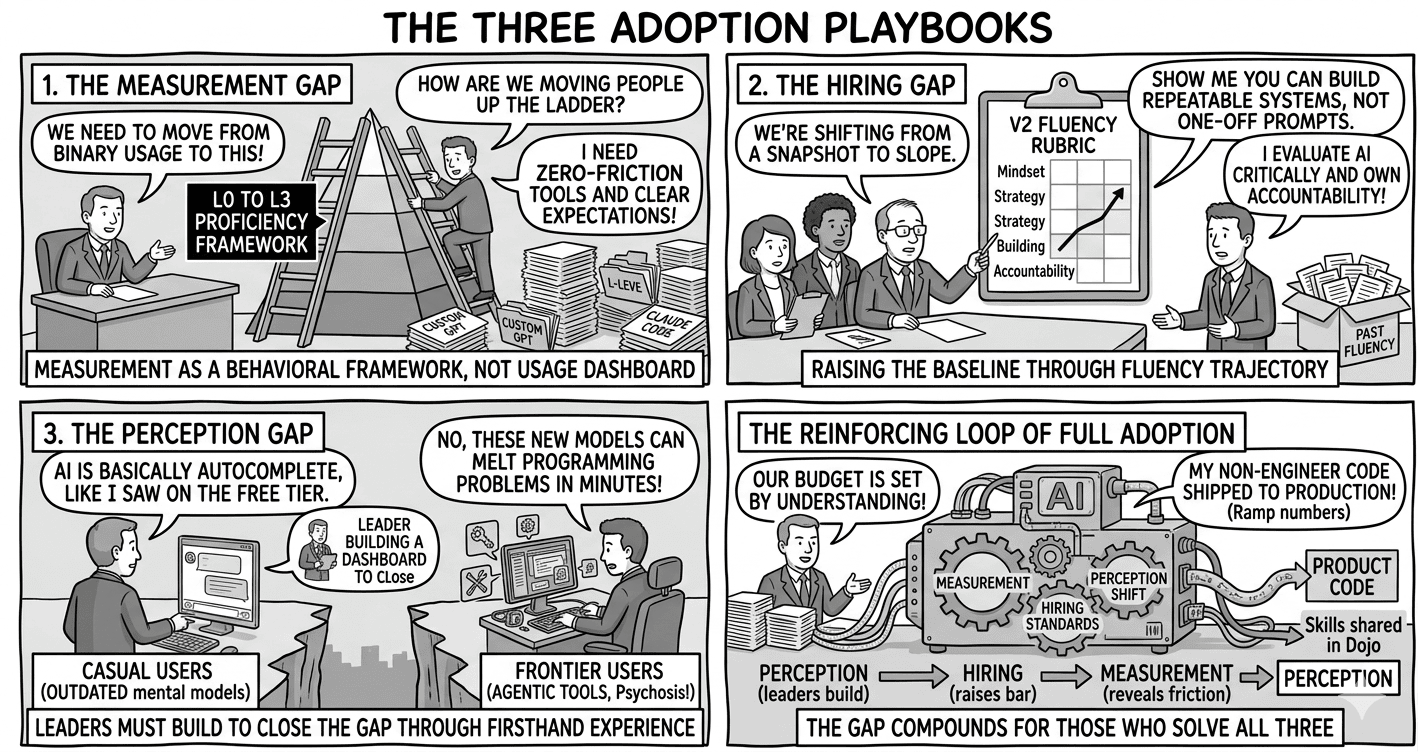
1. Hire for it: every new person raises the bar
The most direct way to build an AI-first culture is through the front door. Every person you add either raises the baseline or dilutes it. Zapier decided to make that a deliberate choice.
Their V2 AI fluency rubric evaluates every new hire across four dimensions:
- AI mindset do you approach work with an AI-first orientation?
- Strategy can you identify where AI creates leverage in your domain?
- Building can you construct repeatable systems, not one-off prompts?
- Accountability can you define "good" upfront, evaluate AI outputs critically, and catch errors before they ship?
The accountability dimension is new in V2, and it contains what I think is the sharpest framing in the entire AI adoption conversation: "With AI, you can delegate the work, but not the accountability." That sentence should be on a poster in every office running AI tools. The failure mode it addresses is real and everywhere: people rubber-stamping AI outputs without exercising judgment. Fluency means using AI well, which means knowing when the output is wrong.
The most interesting change in V2 is the shift from snapshot to slope. Zapier no longer cares only about where you are today. They care about the trajectory. Are you on an active learning curve, experimenting, iterating, improving? Or have you plateaued? A candidate who is at L1 but accelerating is a better hire than a candidate who reached L2 six months ago and has been coasting since.
The rubric also extends to managers. Individual fluency is no longer sufficient for leadership roles. Managers must demonstrate that they have led teams through AI adoption: creating psychological safety for experimentation, setting clear expectations, redesigning workflows. This is the organizational layer that sits on top of individual skill, and most companies are not even talking about it yet.
The 100% company-wide adoption number at Zapier gets all the attention. The rubric is what produced it. By filtering every new hire for AI fluency and trajectory, they are systematically raising the baseline with every headcount. The behavior you want propagates through selection, not persuasion.
2. Grow the team you have: meet people where they are
Hiring sets the bar for the future. But what about the people already on your team? Some are seeing what AI can do and running with it. Others have not changed a single workflow. You need a way to meet both groups where they are and make it clear what great looks like.
Ramp built this. Their proficiency framework is the part of their playbook nobody else is writing about. Most companies measure AI adoption as a binary: are people using it? Yes or no. Ramp rejects that framing entirely. They built a four-level ladder:
The ladder tells people where they stand. But the mechanism for moving them up matters more. Ramp uses three levers. They build tools that meet people where they are (L0 to L1). They raise expectations as the tools mature (L1 to L2). And they match the mandate to the tooling, never demanding more than the infrastructure can deliver. That last one is critical: raising expectations before tools are ready burns credibility.
Then they made progress visible and gave people space. No mandatory training curriculum. No multi-phase rollout plan. Instead, infrastructure for people to teach themselves. An AI guild. A Slack channel with over a thousand members that spun off 40+ sub-channels. Weekly office hours. An internal tool called Glass that auto-configures with connected systems on install. A skills marketplace called Dojo where anyone can package a workflow and share it. Leaderboards that created healthy competitive pressure without being punitive.
The results: 6,300% AI usage increase year-over-year. 1,500 apps shipped in six weeks from over 800 builders. 12% of all human-initiated production pull requests now come from non-engineers. 84% of the team using coding agents weekly. 350+ skills shared in their internal marketplace.
You do not need a formal change management program if you already have the culture and the measurement framework. Ramp did not start with a rollout plan. They started with a culture that already valued speed, then built tooling that made AI adoption frictionless within that culture. The measurement tells people where they stand. The tooling gives them a path up. And the leaderboards make it social. Traditional change management programs solve a coordination problem, but if the culture and infrastructure are good enough, the coordination handles itself.
Together, Zapier's rubric and Ramp's ladder form a complete picture: position plus velocity. Zapier measures which direction new hires are moving and how fast. Ramp measures where every existing person sits and what would move them to the next level.
3. Lead from the front: be the bridge
Hiring and team development both stall without the third piece: leaders who operate at the frontier themselves.
Karpathy's thread names why. There is a massive gap between what casual users think AI can do and what frontier users are actually doing with it. He describes two groups talking past each other. Group 1 tried the free tier of ChatGPT, got hallucinations and viral fumbles, and formed a lasting impression. Group 2 pays for frontier models and uses agentic tools like Claude Code in technical domains, where recent improvements have been, in Karpathy's words, "nothing short of staggering." These models can now "melt programming problems that you'd normally expect to take days or weeks of work."
The gap is structural. AI capabilities are "peaky." Reinforcement learning with verifiable rewards works best in domains where success criteria are explicit: unit tests pass or fail, math proofs check out or do not. Writing, search, and open-ended advice are harder to evaluate, so gains concentrate in technical areas. Even paying $200 a month does not close the gap if you are working in a domain where improvement has been incremental rather than transformational.
This is the leader's problem to solve, and you cannot delegate it. If your leadership team is in Group 1 and your practitioners are in Group 2, your adoption strategy is fighting itself. The people setting the agenda do not believe what the people on the ground are telling them, because their personal experience of AI does not match. The hiring rubric and the proficiency ladder both face resistance when the person holding the budget does not feel the urgency. Or worse: if you are in Group 1 yourself, you cannot influence a change you have not experienced.
The most effective thing a leader can do is build something themselves. When a leader sits down with an AI coding assistant and builds a tool their team actually uses, the perception gap closes through firsthand experience, not slides. I wrote about this recently: a weekend dashboard project changed how 200 people at Typeface think about customers. The dashboard was the easy part. The shift in how leadership talked about AI afterward was the real outcome.
Ramp understood this. Their CEO declared at kickoff they would become "the most productive company in the world." That is a cultural signal as much as a strategic one. It tells the entire organization that leadership is in Group 2, or at least committed to getting there. Without that signal, adoption dies in the middle of the org chart, where people wait for permission that never comes.
You are the bridge between the two worlds Karpathy describes. If you are not crossing it yourself, nobody else will cross it for you.
What breaks when you only do one
The failure modes are predictable. Hiring for fluency without growing the existing team means new people face resistance from the system. Their edge erodes over time, or they stop fighting and conform to the existing pace. Growing the existing team without changing the hiring bar means you miss the catalyst. New hires who arrive fluent bring fresh patterns, raise the energy, and accelerate the people who are ready to receive it. Without that signal from the outside, even a well-built proficiency ladder can plateau. Either one without leadership at the frontier means your budget, your mandate, and your timeline are all set by people who do not understand what is possible.
Ramp's numbers illustrate what it looks like when all three work together: non-engineers shipping production code, internal tools going from concept to deployment in hours, 800 people building 1,500 applications in six weeks. Those outcomes are not available to companies doing only one of the three.
The diagnostic
I work in enterprise AI. I see this pattern across companies of every size and industry: leaders say "AI-first" as if it is one thing, then assign it to one team. HR mentions fluency in the job description. IT handles the rollout. The CEO gives a speech. Nobody connects the hiring bar to the proficiency ladder to the leader's own experience.
The companies that figure this out will not look incrementally better than the ones that do not. The gap will compound, because better hiring raises the team, which improves the tooling, which gives leadership clearer signal, which increases investment in better hiring. Each turn accelerates the next.
If you are leading this, the diagnostic is simple. Would your hiring rubric screen for the fluency your tools now demand? Can you tell me what level your best people are operating at? And when the person setting your AI budget sits down with the tools, do they feel what the practitioners feel? Whichever question you cannot answer is where to start.