A VP of Marketing I spoke with recently had done everything right on paper. Her team deployed a content platform with brand knowledge wired in, quality evaluation on every asset, automated workflows across four markets. The infrastructure was genuine. Six months in, adoption was at 18%.
She understood the technology. What stumped her was the people. "The platform works. I've used it myself. But my team runs the old process alongside it, and I can't figure out why."
We started working through it together. Does the approval screen show reviewers what the system considered and where it was uncertain, or does it just present a finished asset? When the UK team discovers that a messaging angle resonates, does that insight reach APAC automatically? When the best content strategist built a workflow that cut production time in half, did the rest of the team inherit it?
She already knew the answers. Three no's.
If you're deploying AI at organizational scale, you've probably felt at least one of these.
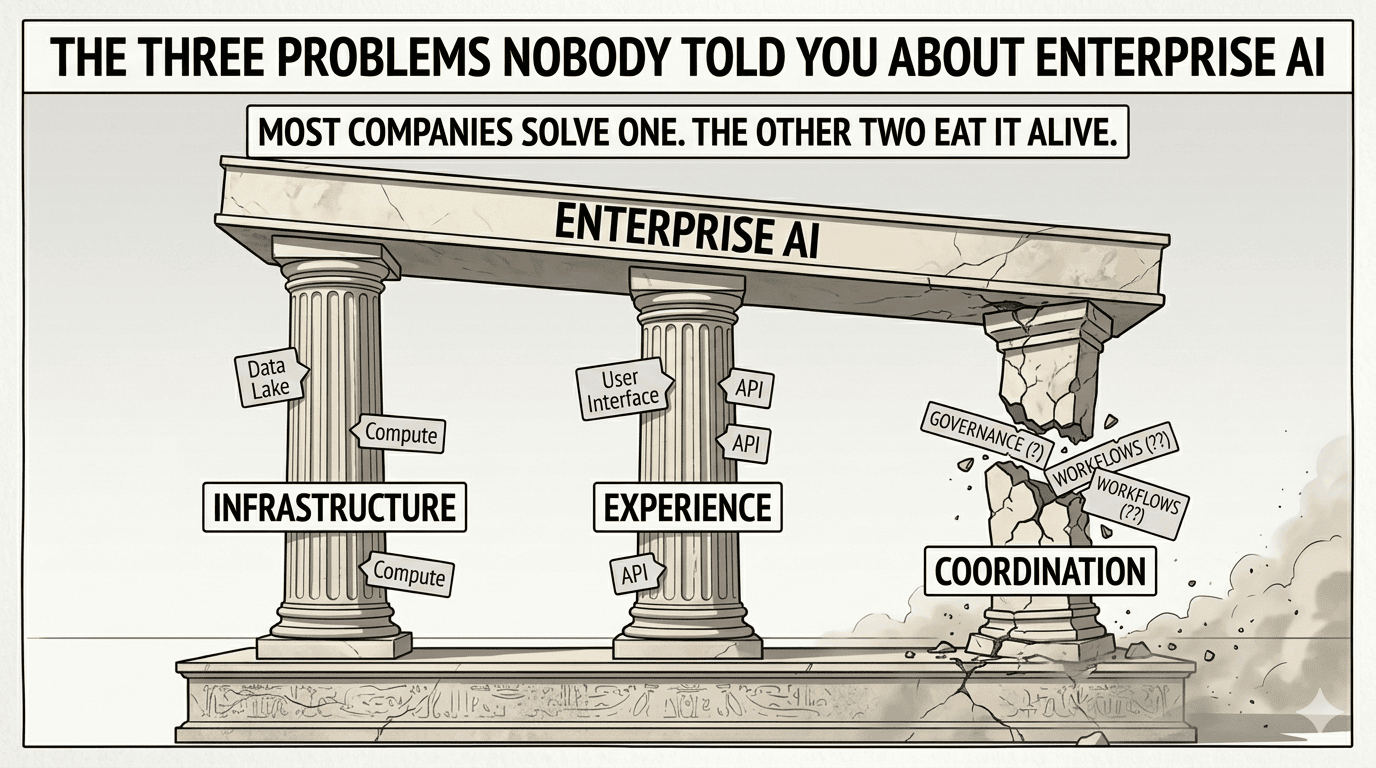
Over the past few months, I've written about three problems that keep surfacing in enterprise AI deployments. The infrastructure gap between generating content and operating a content system at scale. The experience gap between building for agents and building for the humans who oversee them. The coordination gap between one person's AI workflow and an organization's collective capability. The infrastructure gap is what I work on at Typeface. The experience and coordination gaps are what I see in every deployment conversation.
I wrote about each one separately. What I didn't see clearly until watching deployments like hers is that they form a compound: solving any one or two without the third is why most enterprise AI deployments plateau. Understanding how these three problems interact matters more than evaluating any individual tool.
How the problems compound
These three dimensions form feedback loops. When one is missing, it actively degrades the other two.
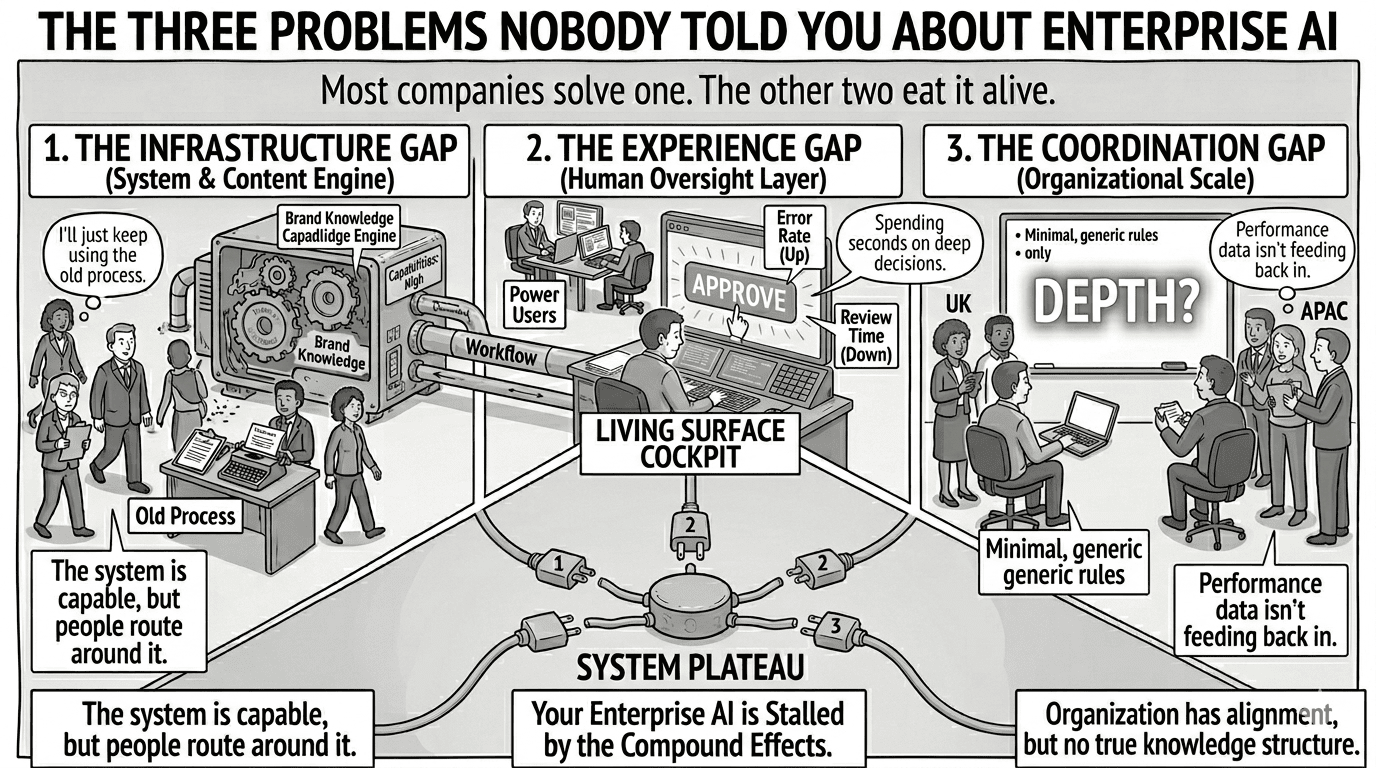
Infrastructure without coordination produces what I think of as the ghost system. You invest in a content operating system. Brand guidelines are encoded. Workflows are automated. Quality evaluation runs on every asset. But the 40-person marketing team wasn't involved in defining those workflows, and the regional teams have approval norms the system doesn't reflect. The platform is capable and the organization is foreign to it.
Usage clusters around the 3-4 people who helped configure it. Everyone else routes around it. This is the most common failure mode I see. Without shared governance across the organization, the system serves a few power users while everyone else maintains parallel processes. The tell: dashboards show that the majority of content is still being produced outside the platform, or the same asset gets created twice because teams didn't know the system already had it.
Coordination without the right experience layer produces rubber-stamping. You get the whole team onto the platform. Everyone has access. Governance structures exist. But the translation layer between AI output and human judgment is missing. A regional marketer adapting a campaign for Germany sees the final asset but nothing about why the system chose that angle, what alternatives it considered, or where its confidence was low. She spends 90 seconds on a decision that deserves five minutes, because the screen doesn't support better judgment.
This failure mode is quieter and more dangerous. The adoption numbers look strong. But the quality of human oversight is eroding because the product surface discourages careful review. The team achieved coordination on a foundation that undermines good decisions. It shows up when approval turnaround gets faster but error rates creep up, or when reviewers start clicking "approve" without opening the full asset.
Experience design without infrastructure produces beautiful empty rooms. You build thoughtful oversight screens, progressive trust controls, rich context around every decision point. But brand knowledge isn't structured underneath. Performance data doesn't feed back in. The interfaces are elegant but surface shallow information, because the systems behind them don't supply anything deeper.
The hardest pattern to spot, because the product feels good. Users find it intuitive. But the decisions they're making are uninformed: the knowledge layer and measurement loops that should power those surfaces haven't been built. The giveaway is when the team loves the interface but the outputs feel generic, or the same mistake appears across campaigns because no learning loop corrects it.
Why solving them in order fails
The natural instinct is to sequence: infrastructure first, then experience, then coordination. Build the system, design the surfaces, get the team on board.
This sequence is logical and wrong.
By the time you've spent six months on infrastructure, the team has developed habits around the old process. The coordination problem has hardened. And the experience layer was designed without input from the people who will actually use it, because they weren't using the system yet.
Microsoft's 2026 Work Trend Index surveyed 20,000 workers across 10 countries and found that culture, manager support, and talent practices determine whether companies get real value from AI more than individual skill or tooling. That finding makes more sense when you see these three problems as a system rather than a sequence.
The leaders I've watched break through do something counterintuitive. They work on all three simultaneously, in thin slices.
Instead of building the full infrastructure, designing the complete experience, and rolling out to the entire organization, they pick one workflow. The one where the team feels the most pain. A single campaign type, a specific approval flow, one market.
For that workflow, they wire the infrastructure: brand knowledge connected, performance data feeding back. They design the experience: approval surfaces that show the system's reasoning, trust controls that start conservative and expand. And they bring the team in from the start, defining governance together rather than handing them a finished system.
One marketing organization I've watched do this well started with their product launch announcement workflow: high pain, medium complexity, cutting across every dimension from brand compliance to regional adaptation. Within eight weeks, that single workflow was running through the full compound: infrastructure feeding the approval screens, the team governing their own rules, human overrides feeding back into the system's judgment about their context. By their fourth workflow, they were onboarding new campaign types in days instead of months.
Then they expand. Each new workflow inherits what the previous one taught the system. The infrastructure gets richer because the experience surfaces real usage data. The coordination norms propagate because people helped build the thing they're adopting. Organizational capability compounds instead of plateauing.
It's slow at the start. By month six, it's faster than any alternative I've seen.
Where you're stuck
If you're sensing a plateau, the interaction patterns point to the breakdown.
Strong infrastructure, low adoption: coordination problem. The system works, but it doesn't reflect how the team operates. Involve the team in defining the workflows and governance. Better onboarding won't fix a system that was designed without the people who need to use it.
High adoption, declining output quality: experience problem. People are using the system, but the oversight surfaces aren't supporting good judgment. Redesign the decision interfaces so reviewers get the context to make real calls.
Strong team alignment, shallow results: infrastructure problem. Everyone's on board, but the underlying data and feedback loops aren't there. Strengthen what sits behind the surfaces people are already using.
Most organizations have at least two of these happening simultaneously. The diagnostic value is seeing which interaction is doing the most damage.
What this means for your career
The roles that matter in enterprise AI over the next few years will be the ones that work across all three dimensions. The content strategist who understands infrastructure architecture well enough to specify what the system needs. The product designer who can facilitate governance conversations with marketing teams. The engineering leader who builds for organizational learning.
The specialist who goes deep on one dimension and ignores the other two will keep producing work that's excellent in isolation and stuck in practice. That was a viable career posture when the problems were separable. They aren't anymore.
If you're the person in your organization who already sees these connections, the move is to make them visible. Name the compound. Show the team where one dimension is degrading the other two. That diagnostic capability is rare, and becoming more valuable by the quarter.
The pattern underneath
This compound isn't new to AI. Cloud migration had the same shape: companies that sequenced infrastructure, then UX, then change management spent years stuck in "lift and shift." The ones that redesigned workflows around cloud-native capabilities from the start, even if the first iteration was rough, moved faster. Enterprise AI is the current version of that pattern, moving faster than previous transitions, which means the compound hits sooner.
If your organization is stuck, you probably picked the right tool and the right team. The problem is that you're solving one dimension while the other two quietly erode your progress. Name the three. See the compound. Work on them together.
This piece draws on three earlier articles: "From Content Generation to Content Operating System," "Building for the Agent Experience Gap," and "AI Productivity Has a Multiplayer Problem." Each explores one dimension of the compound described here.